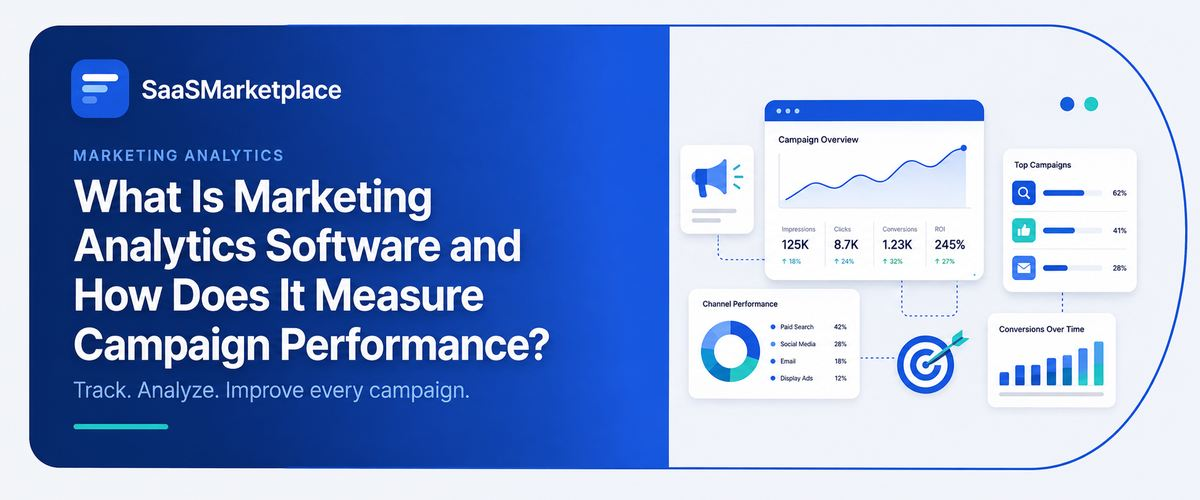
What Is Marketing Analytics Software and How Does It Measure Campaign Performance?
-min.jpg)
A marketing manager opens four different dashboards every Monday morning, copies the numbers into one spreadsheet, and by the time she's done, half of it is already a week stale. This is basically the whole reason marketing analytics software exists it pulls the numbers in from every channel automatically, so nobody has to do that copy-paste job by hand each week just to see what's actually working.
 Looking for Marketing Analytics Software? Check out SaaS Marketplace’s List of the Best Marketing Analytics Software in the USA for your business.
Put plainly, it tracks specific actions and ties them back to whichever campaign caused them, then turns that into something a team can look at and actually use. Whether it's worth setting up has less to do with company size and more to do with how many separate tools are currently giving conflicting answers.
Key Takeaways
- Marketing analytics software tracks campaign performance by connecting specific actions clicks, signups, purchases back to the campaign, channel, and even the individual ad that drove them.
- It works best paired with marketing automation software, since automated campaigns generate the kind of clean, structured data analytics tools actually need to measure anything accurately.
- For most day-to-day decisions, real-time reporting matters more than historical reporting, though both still have their place.
- Attribution is the hardest part to get right; even sophisticated marketing attribution software is making assumptions under the hood, and those deserve a skeptical look rather than blind trust.
- Most reporting problems come down to a messy tracking setup, not a weak analytics tool.
What Marketing Analytics Software Actually Measures
Strip away the dashboards and reports, and this software is doing one core thing: connecting an action a person took to the campaign that caused it. Someone clicks an email link, someone submits a form, someone completes a purchase; the job is tying that event back to a specific source, whether that's a particular email send, a paid social ad, or an organic search result.
Simple enough, until a business is running more than one channel. Take an ad someone scrolls past on Monday, a retargeting email that lands on Wednesday, and then a click on a paid search ad Friday that finally turns into a sale. So who gets credit for that? That's the actual work the software is doing: running different models like last-click or first-click, or something that spreads it out more, to figure out how the credit gets divided up.
Beyond individual sales, most platforms also pull in aggregate numbers cost per acquisition, return on ad spend, engagement rate, and where people drop off in the funnel. On their own, none of it tells you much. An ad can have a great click-through rate and still never convert anyone, and a smaller campaign with weaker traffic but people who actually stick around can quietly outperform something flashier-looking.
Why Measurement Got Harder, Not Easier
A decade ago, a company running one or two channels could track performance reasonably well with basic reporting. That's no longer realistic for most US businesses. The average marketing team now runs paid social, email, organic search, and often a mobile channel simultaneously, each generating its own data in its own format.
Then privacy rules made things worse. Between browser tracking limits and third-party cookies slowly disappearing, the cross-site tracking a lot of marketers built their whole reporting habits around got a lot shakier. Plenty of businesses kept running things the same way, not realizing that a growing chunk of their conversions were quietly getting logged as "direct" or "unknown," not because people stopped converting, just because the old tools stopped seeing them.
That's part of why AI marketing tools have crept into more analytics platforms lately it's less a trend and more a patch for messier data. A model can catch a gap or flag something odd a lot faster than someone squinting at rows in a spreadsheet, though somebody still needs to actually check that output before trusting it.
Real-Time vs. Historical Reporting
One issue that often appears during platform evaluations is treating real-time and historical reporting as the same thing with different refresh rates. They're not. Real-time reporting is built for in-flight decisions pausing an underperforming ad set, reallocating budget mid-campaign, catching a broken landing page before it burns through a day's spend. Historical reporting is built for pattern recognition across weeks or quarters, shaping next quarter's strategy rather than today's budget.
Teams that only look at real-time dashboards tend to overreact to short-term noise a bad Tuesday doesn't necessarily mean a campaign is failing. Teams that only review historical reports tend to miss problems they could have caught and fixed within hours. A good analytics platform supports both, but a team still has to build the habit of using each one for what it's actually good at.
How This Connects to the Rest of the Marketing Stack
Analytics software rarely does its job well sitting by itself. Cut it off from the rest of the stack and the reporting gets thin fast.
Marketing Automation Software
Automated campaigns just produce better data, full stop every trigger, send, and follow-up gets logged the same way every single time, no gaps. A team running automation alongside their analytics ends up with a much more complete picture of the customer journey than a team piecing it together from manual sends and hoping the timestamps roughly line up.
All-in-One Marketing Platform
More and more businesses are running analytics as just one piece inside a bigger all-in-one platform, rather than bolting on a separate tool. There's a real upside campaign data, automation, and reporting all draw from the same pool of data, so you skip a lot of the export-and-reconcile busywork. What you give up is customization; a bundled module usually can't match a standalone product built specifically for deep analysis.
Marketing Attribution Software
People conflate attribution and analytics all the time, but they're not the same job. Attribution is narrowly about who gets credit for a conversion across multiple touches; analytics covers a lot more ground than that. Teams that treat basic analytics like it's attribution often end up crediting the wrong channels without realizing it.
Marketing Planning Software
Planning and measurement should inform each other, but in a lot of companies they don't. Marketing planning software determines what gets built and when; analytics determines whether it worked. Teams that keep these disconnected often plan next quarter's campaigns on gut feeling rather than what last quarter's data actually showed.
Mobile Marketing Software
Push notifications and SMS campaigns generate their own performance data, and mobile marketing software needs to feed that into the same analytics environment as email and social otherwise a team ends up with a blind spot around a channel that, for a lot of audiences, gets opened faster than anything else.
Social Media Marketing Software
Every social platform hands you its own analytics, and none of them quite agree each one counts engagement its own way. Route that data into a shared analytics tool instead, and at least everyone's working off one yardstick instead of five that don't match.
Common Mistakes Companies Make
Certain mistakes just keep showing up, over and over, whenever analytics rollouts don't end up delivering anything useful.
Tracking setup gets rushed. Teams often install analytics software and start reporting within days, without properly configuring UTM parameters, conversion events, or goal definitions first. Smaller companies especially tend to overlook this step, assuming default settings will capture what matters to their business.
People fall for vanity metrics constantly impressions and click-through rates make for an easy slide in a meeting, but they say nothing about whether money actually came in. Meanwhile, a small, well-targeted audience quietly converts better and ends up being the more profitable channel, even though its numbers look unimpressive next to the big ones.
How to Get Real Value From Marketing Analytics Software
Before you even open a dashboard, decide what actually counts as a conversion. Someone signing up for a free trial and someone actually paying you are two very different things lump them together in your reporting and everything downstream gets skewed.
Pick your attribution model on purpose. Don't just leave whatever came pre-set by default. Last-click is the easy option but it tends to shortchange whatever happened earlier in the journey; a multi-touch setup takes more work to configure but tends to hold up better once you're running several channels at once.
Put reports on a fixed schedule instead of only glancing at them when something feels off. Teams checking weekly catch small problems while they're cheap; teams that wait find out three months later, as one very large, unpleasant number.
Connect analytics to the tools generating the campaigns themselves, whether that's marketing automation software, social scheduling tools, or mobile channels. If the data's siloed, that's usually the actual reason the reporting misleads people, more than any flaw in the tool itself.
And treat anything AI flags as a lead worth checking, not a verdict. These tools are genuinely quick at catching patterns a person would miss, but figuring out what to actually do about it still takes someone who knows the business that part the software can't do for you.
When Analytics Software Alone Isn't Enough
No amount of clean software fixes a bad strategy underneath it. Analytics can show you what happened. It can't tell you why on its own, and it definitely can't replace someone sitting down and actually thinking about what those numbers mean for the business.
Company size and marketing complexity shape how much analytics investment actually makes sense. A business running one or two channels with a modest budget doesn't need the same depth of reporting as a company running paid social, email, search, and mobile at once across multiple audience segments. A single-channel shop paying for an enterprise-grade setup is usually just paying for features it'll never touch.
And it's fair to say plainly: the more granular you want your tracking, the more time you'll spend setting it up and keeping it running. What's right for a given business comes down to how much budget is riding on the answer and how much sharper measurement would actually change the decision not whichever platform has the flashiest feature list.
Conclusion
Marketing analytics software measures campaign performance by connecting specific actions to specific sources, then organizing that data into a form a team can actually act on. The businesses getting real value from it aren't necessarily running the most expensive platform on the market they're the ones with clean tracking setups, a deliberate attribution approach, and someone who actually reviews the reports on a consistent schedule instead of letting dashboards collect dust.
FAQ's
Analytics software covers a broad range of performance metrics across channels, while attribution software focuses specifically on crediting conversions to the touchpoints that led to them. Most analytics platforms include some attribution functionality, but dedicated attribution tools go deeper on that one function.
It depends more on the number of channels in use than on company size. A small business running one or two campaigns can often track performance manually, but once three or more channels are active, manual tracking becomes unreliable fast.
A bundled analytics module inside an all-in-one marketing platform pulls from the same shared dataset as the rest of the platform, which simplifies reporting. A standalone analytics tool often offers more customization but requires manually connecting data from other systems.
Not entirely. AI tools are useful for spotting patterns and filling attribution gaps faster than manual review, but interpreting what those patterns mean for the business still requires human judgment.
Weekly reviews tend to catch problems early enough to fix them cheaply, while monthly or quarterly reviews are better suited to spotting broader strategic trends rather than day-to-day campaign issues.