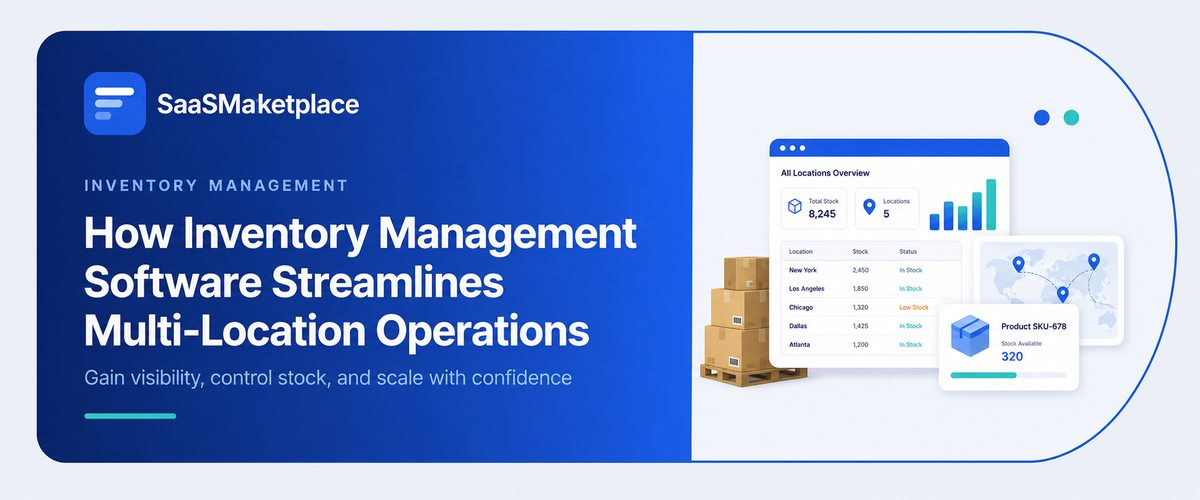
How Inventory Management Software Streamlines Multi-Location Operations
-min.jpg)
When inventory is managed in several warehouses, retail stores, or fulfillment centers without one central system, this can result in expensive stockouts or excessive inventory. The latest inventory management technology promotes efficiency in multi-location operations by being a one-stop shop for information and providing real-time information regarding inventory levels and movement, as well as automated routing of orders across the various physical and digital sales channels. When information is collected in one system, companies save on labor costs due to reduced need for manual management, as well as maintain reduced inventory holding costs.
What Is Inventory Management Software and How Does It Support Multi-Location Operations?
Inventory management software is a digital system that helps to application performance monitoring levels, sales, purchasing activities, and physical stock movements throughout the whole supply chain. By replacing inefficient paper-based spreadsheets with a real-time automatic control system, the program makes it possible to know what products are kept in stock, where they are located, and when it is necessary to restock. It directly connects with cash register software and e-commerce sites to provide reliable real-time stock balance updates with every transaction.
In firms with multiple processing bays, be it in retail stores, warehouses at various locations, or facilities of third-party logistics service providers, that software acts like the only source of truth, so that operational segmentation is ruled out by it. Managers can monitor inventory in peripheral locations via the only dashboard, establish specific reorder points for the related locations, and fulfill inter-location stock transfer requests on a timely basis. Besides, smart order routing technologies ensure that customer requests for any products are fulfilled from the nearest possible place where the necessary stock is available, cutting out a huge amount of time and costs during transportation phases and, eventually, increasing levels of satisfaction expressed by customers.
What Are the Biggest Challenges Inventory Management Software Solves Across Multiple Locations?
Managing inventory across several warehouses or retail stores presents complex logistical issues, but inventory management software helps overcome these problems:
- Elimination of Stockouts and Overstocking: With centralized inventory tracking, it becomes easier to monitor stock levels in real-time and reorder hot-selling units while avoiding unnecessary expenses due to excess inventory.
- Correction of Errors Related to Inventory Tracking in Multiple Locations: Thanks to automated inventory updates, there is no need for manual bookkeeping, thus preventing any errors in record-keeping.
- Facilitation of the Process of Transferring Stock Between Locations: With a detailed insight into the entire stock of the company, it's now possible to make transfers of the excess stock from one site to another instead of placing orders with providers.
- Elimination of the Problem of Dead Stock: Automated tracking allows the business to be aware of the older stock first of all, thus allowing it to avoid expiration and write-offs
- Improvement in Demand Forecasting in the Supply Chain: Software programs analyze current data regarding sales in various locations to provide accurate demand forecasts.
- Reduction of Labor and Operation Costs: Barcoding and automation help reduce labor time and costs related to the inventory picking process.
How Does Inventory Management Software Improve Real-Time Stock Visibility Across Sites?
The software used for managing inventory allows one to track each step of the process without losing visibility into what happens at each moment, from warehouses and distribution centers to retail stores, while preventing the emergence of data silos by integrating tracking and monitoring all processes.
-
Cloud-Based Central Database
It unites data on stock levels coming from warehouses, shops, and transit locations in one location (the dashboard) that can be accessed from any place.
-
Barcode and RFID Interface
The software scans products while receiving, moving, or picking them, adding data on the product immediately to the database.
-
Automation of Point of Sale Work
The software subtracts sold goods from the inventory database immediately at the moment when the goods are sold, thus preventing double sales.
-
Real-Time Tracking of Products in Transit
It accurately knows where each item of stock is currently and can stop its being marked as missing or available.
-
Automation of Alerts on Low Stock Situation
The system keeps notifying the warehouseon and making purchases when the inventory level of the product drops below a predetermined threshold.
-
API Integration with Sales Channels
With this seamless sync of inventory across e-commerce sites & platforms, marketplaces, and retail stores, stock quantities can easily be managed.
-
Quick Multi-User Activity Monitoring
All actions with stock, returns, and audits are recorded instantly, allowing the owner to keep control of everything that is happening.
How Does Inventory Management Software Keep Stock Counts Accurate at Every Location?
- Cycle Counting Automation: The automated approach periodically accounts for a small segment of product types as opposed to relying on a yearly manual cycle count, enabling the detection of differences earlier and allowing operations to continue uninterrupted.
- Scanning via Barcodes and QR Codes: Staff are responsible for scanning realized products throughout the receiving, picking, packing, and transfer stages, which aids in the prevention of errors and manual oversight.
- The Implementation of a Centralized Perpetual Inventory System: Using real-time inventory updates in all branches, this system tracks all operational processes undertaken in each branch and makes sure that all branches are prompted by the same source of knowledge.
- Standardization of Receiving Procedures: The system compares the received shipment with a digital purchase online order (PO reconciliation), ensuring that only real products are recorded in stock count.
- Verification of Transfers: The company tracks movements of products in transit using a sent and received status, thus preventing the product from being lost or counted twice.
- Automatic Logging of Waste and Returns: Using the automatic system, damaged or returned items are sorted into specific non-sellable inventory so they are not included in sold inventory.
How Does Inventory Management Software Speed Up Order Fulfillment Between Warehouses?
The software for inventory management streamlines order fulfillment by implementing automatic decision-making, optimizing travel time, as well as helping with communication between facilities.
-
Distributed Order Routing (DOR)
The software automatically sends orders coming from customers to the warehouse that is closest to the destination and has the stock of required products awaiting dispatch.
-
Optimized Pick Lists and Batch Picking
It provides workers with the shortest way to work places and consolidates many orders for their handling.
-
Automated Stock Transfer Requests
The program makes stock transfer orders when there is a risk of a stock shortage in regional warehouses.
-
Real-Time Order Allocation
The software allows reserving the items ordered immediately after a customer has made order payment.
-
Direct Integration with Shipping Carriers
The system creates shipment labels, packing slips, and custom instructions for sending the shipments automatically, removing human error at the packing stage.
-
Split-Order Optimization
The software can tell when orders need to be separated among several warehouses to make deliveries in a timely manner.
-
Barcode-Guided Mobile Fulfillment
This is a tool through which warehouses can easily locate and pick goods needed for a customer.
What Reporting and Analytics Does Inventory Management Software Provide for Multi-Site Businesses?
The implementation of inventory management software allows businesses operating in various locations to have real-time data about their operations, which leads to more informed accounts, as well as real-time reports specific to every facility.
-
Inventory valuation reports for every facility
Takes account of overall asset value, costs of holding the product, and cost of goods sold across various stores.
-
Inventory turnover rate
The rate of stock turnover is indicated and allows the owner to assess the performance of each store.
-
Forecasting in connection with place of demand
This method uses sales patterns of the past and seasonal variations to assess future needs in every store.
-
Classification and assessment of product profitability
The classification entails distinguishing different products according to their profitability and sales rate to allow for efficient allocation of resources.
-
Accounting logs of stock transfers
It describes the specifics of stock transfers within or across stores.
-
Assessment of supplier effectiveness
This measure helps in negotiating with suppliers based on their performance.
-
Reports on Stockout, Shrinkage, and Deadstock Audits
The report identifies the specific facilities with the highest amount of lost sales due to stockouts, employee theft, damage, or obsolete products.
What Business Impact Can You Expect From Inventory Management Software Across Your Operations?
|
Business Area |
Operational Impact |
Financial & Strategic Results |
|
Working Capital |
Eliminates over-purchasing and reduces safety stock buffers. |
15%–30% drop in holding costs, freeing cash for expansion and marketing. |
|
Sales Growth |
Keeps high-demand SKUs stocked across all physical and digital channels. |
10%–25% increase in top-line revenue by eliminating lost sales from stockouts. |
|
Labor Efficiency |
Automates manual counts, order routing, and PO generation. |
Up to 40% reduction in labor hours spent on administrative inventory tasks. |
|
Fulfillment Speed |
Optimizes picking routes and automates order allocation. |
50% faster order processing times and reduced expedited shipping fees. |
|
Stock Accuracy |
Uses barcode scanning and real-time ledger updates. |
Achieves 98%+ inventory accuracy, virtually eliminating write-offs and shrinkage. |
|
Customer Retention |
Ensures accurate stock counts online and prompt deliveries. |
Higher CSAT scores and higher customer lifetime value due to fewer canceled orders. |
Conclusion
Adopting the inventory management application transforms disorderly logistics in a multi-site environment into a robust framework for business success. The system makes it possible to have better control over the stock, automate logistics operations, and reduce human errors. The implementation of the right solution makes it easy for a company to adopt various inventory systems, minimize deadstock, and enhance order fulfillment. Interested in upgrading your operation? Access SaaSMarketplace and find the best software for your inventory management needs.
FAQ's
It tracks real-time inventory levels across warehouses, retail stores, and fulfillment centers within a centralized database.
Yes, it detects regional stock shortages and automatically generates inter-warehouse transfer orders to balance inventory.
It updates available stock levels instantaneously across all sales platforms whenever an item is purchased at any location.
Prioritize real-time visibility, automated reordering, location-specific demand forecasting, and multi-warehouse order routing.
It aggregates performance data into unified reporting dashboards while allowing managers to filter metrics down to individual store or warehouse levels.