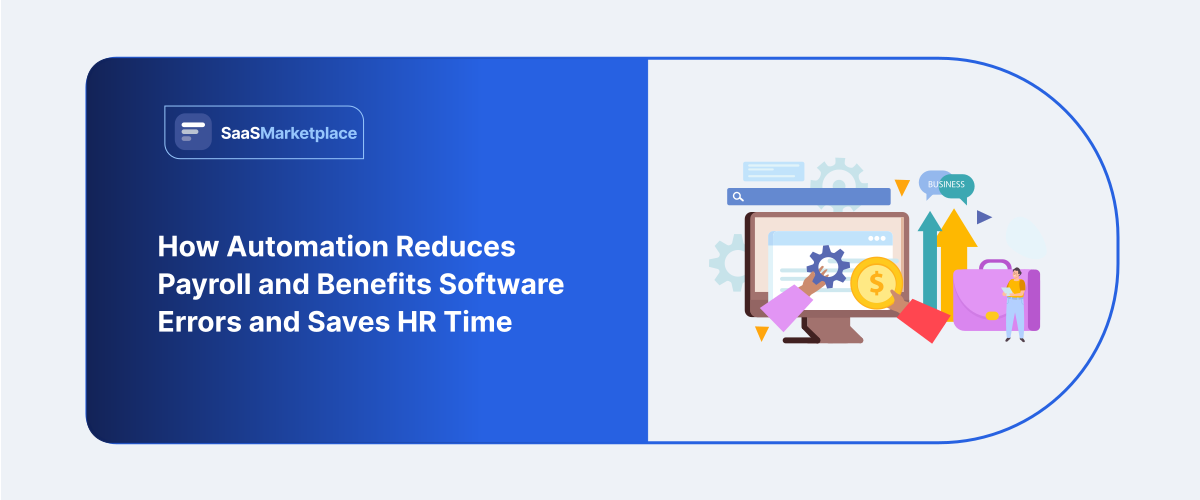
How Automation Reduces Payroll and Benefits Software Errors and Saves HR Time
-min.jpg)
Manual processing of payroll is not only a cumbersome task for American HR teams; it is downright dangerous as well due to the complicated federal regulations as well as different tax stipulations imposed by each state. Whether it’s calculating the overtime according to the Fair Labor Standards Act, following regulations related to local taxation, or trying to make sure that the correct amounts are deducted from 401(k), health insurance, and similar types of plans, one mistake in calculations may lead to large fines from the IRS or dissatisfaction from the staff, as well as results in hours of work spent on correcting the errors. With the help of an automatic payroll system, HR people will need to deal with the issue of data input manually.
What Is Payroll and Benefits Software?
Payroll and benefits software products help businesses in the USA monitor how they pay their employees and compensate them for tax payments and health or pension benefits. The payroll and benefits software performs all the calculations without the need for spreadsheets or separate software, as all processes are automated. Moreover, since each state has its own tax regulations, payroll and benefits software also takes care of all employees' tax calculations.
These platforms don’t merely issue payroll checks. They connect the organization, employees, and third-party carriers. With the help of an online self-service portal, employees can enroll in health insurance, modify their direct deposit data, or tweak their tax withholding form. The system operates through APIs, enabling real-time data sharing with insurance agencies, retirement administrators, and other authorized institutions, including the IRS. By consolidating payroll-related data and benefits services operations under one roof, the human resources department minimizes administrative expenses, secures compliance with FLSA, and makes sure that employees receive payments correctly and on time.
What Are the Common Errors in Payroll and Benefits Software?
Even in this age of modern technology, glitches occasionally occur. This usually happens when manual information input, disconnected systems, or wrong configurations are involved in the process. In the American market, among the most common errors is wrong calculation of payroll software tax and reporting. Federal amounts changing, tax laws differing in various states, and local tax withholdings make it easy to misclassify employees, fill out the W-4 form incorrectly, and lead to insufficient withholdings, which can incur unpaid payroll taxes and subsequent IRS penalties.
Another considerable headache arises from poorly managed benefit deductions and failures of the carriers to synchronize records. If an employee has a life event during the year such as adding a spouse to the health insurance plan or changing contribution rates to the 401(k) and the payroll department fails to update either payroll or the benefits provider, discrepancies could arise. Employees may find that too little has been deducted from their paychecks, requiring HR to collect retroactively, or they may pay for premiums of benefits that were never received.
Most importantly, compliance errors regarding recordkeeping of working hours and leave instances often spark labor conflicts. Mistakes in calculating non-exempt work under the Fair Labor Standards Act (FLSA), inaccurate deductions for paid time off (PTO), or incorrect records of mandatory paid sick leave will lead to audits and salary reclaims. Therefore, if the payroll and benefits software does not integrate well with timekeeping systems, such mistakes happen without difficulty.
How Does Automation Reduce Payroll and Benefits Software Errors?
Automation prevents mistakes as it substitutes manual data entry with syncing of time tracking app & software with benefit providers and payroll systems. Instead of making manual entries that require HR personnel to write down the hours worked on a time card or re-enter benefit elections during the enrollment period, automation takes care of the whole thing instantly. This reduces errors associated with manual typing and thus guarantees that 401(k) payments, health care fees, and flexible spending accounts match the employee elections perfectly at all times.
The solution ensures that businesses are always compliant with the complex and always-changing tax and labor laws without any manual intervention in this process. Automated systems perform withholding correctly and in compliance with the employment regulations, which is important when employees work remotely in several states at a time. Automated software does calculations of overtime pay rates, shift differentials, and sick leave accruals required by the law, thus preventing employers from being fined by the Department of Labor.
Automation identifies inconsistencies before payroll processing through various pre-payroll audit triggers incorporated in modern systems. These systems are able to continuously verify input from timesheets, tax forms, and benefit tier adjustments, notifying HR staff about any discrepancies that might arise prior to money being sent. This early detection reduces the extent of unexpected manual corrections, issues of retroactive benefit payments, and HR's efforts associated with resolving disputes regarding paychecks.
How Does Automated Payroll and Benefits Software Save HR Time?
- It eliminates manual data entry and spreadsheets.
This synchronization system is capable of automatically transferring data regarding hours, wages, and benefit choices into payroll software without any prior operations.
It stops the endless chain of checking and rechecking several spreadsheets used for deductions, bonuses, and PTO accruals.
- Automating the benefits enrollment process and synchronizing with carriers.
Using EDI feeds, insurance companies receive data directly from the employees’ organs without any involvement of HR personnel.
Now employees can complete their open enrollment by themselves: the service allows them to do everything on their own via self-service portals.
- Simplifying Complicated Tax Compliance on Federal, State, and Local Levels
It automatically keeps the withholding factors up-to-date for employees who travel for work or work in various states, so no need to research tax rates.
Automated generation and distribution of accurate 1099s and W-2s as well as quarterly tax returns.
- Automating Time Tracking and Calculating Overtime
Automatically processes digital time sheets into payroll figures in a matter of seconds, applying complex FLSA rules and shift differentials.
Automatic tracking of state-mandated paid sick leave and PTO accruals, avoiding manual computations at every pay period.
- Minimizes HR Inquiries from Employees by Utilizing Self-Service Portals
Workers can access pay statements, monitor vacation balance, as well as modify direct deposit details without having to contact HR.
Regionally increases the ability to digitally access tax documentation and information on benefit accords, significantly decreasing the number of similar emails.
How Does Payroll and Benefits Software Improve Compliance and Accuracy?
It is challenging for businesses in the United States to stay compliant with the numerous changes to federal, state, and local laws, but technology can help. Automated payroll and benefits software increases accuracy by including labor laws and tax regulations in its calculations, whether through automated updates of federal taxes, the ability to manage remote workers with taxes from different states in mind, or by analyzing components of Social Security (FICA).
In addition to handling taxes, these services provide an automated compliance solution for difficult federal laws such as the Fair Labor Standards Act (FLSA), Affordable Care Act (ACA), and ERISA. This tool monitors employee working hours and determines legitimate non-exempt overtime and checks ACA thresholds for determining the full-time status of employees regarding health benefit offers and 401(k) deductions to prevent violations of the legislative mandates regarding retirement plan contributions. Automating this process enables HR departments to avoid expensive audits and fines imposed by the Department of Labor.
With the help of automated pre-payroll validation and digital audit trails, accuracy is preserved. Before sending any money out, the software conducts investigations on employees’ timesheets, benefits deductions, and tax profiles, pinpointing discrepancies, which include wrongly reported W-4 information or inexperienced time logs. Each movement, change in benefits, and tax information is kept in an orderly central record, making it easy for HR departments to compile records for internal auditing or regulatory purposes.
What Are the Cost Savings from Automated Payroll and Benefits Software?
-
Removes Expensive Human Errors in Payroll and Overpayments.
Preventing direct financial losses due to double payment, placement of decimals in the wrong place, missing wages, and calculations of overtime pay.
Stopping ‘time leak’ and buddy punching through attaching a digital time clock.
-
Avoiding Heavy Fines and Penalties.
Avoiding heavy penalties from the IRS for late, less, or incorrectly solved federal, state, and local taxes.
-
Minimizes Insurance Coverage Overcharges by Synchronization of Carriers
Gets instant alerts to insurance carriers about an employee quitting or dropping coverage to ensure no organization is incurring charges for non-existent insurance premiums.
Provides a clean deduction rate for deductions from pay to remove the need for prior adjustments in case the employer incurs a loss as a result of non-payments.
-
Decreases the administrative costs of HR/Payroll Processing
Reduces processing duration from days to hours, allowing companies to grow their workforce without getting additional administrative personnel.
How Do You Choose the Right Payroll and Benefits Software for US Businesses?
-
Verify multi-state tax and local compliance strengths
Pick software that can automatically track and work out shifting federal, state, and city tax rates. This is really important, especially when you’re managing remote or hybrid staff, because the rules can change depending on where people sit. Make sure the platform is also set up for automated quarterly state and federal tax filings. Plus, it should cover year-end W-2 and 1099 outputs and keep tax tables current, in real time, as policy updates happen.
-
Assess carrier connectivity and benefits administration fit
See if the tool offers direct electronic interchange, or real-time API connections with major insurance carriers, so it can automate open enrollment. Also check it supports mid-year qualifying life event adjustments without you doing extra clicks. Confirm it handles pre-tax vs post-tax deductions for 401(k) plans, HSAs, FSAs, and health insurance too, without any manual spreadsheet syncing or copy-paste.
-
Evaluate Time Tracking and FLSA Overtime Integration
Pick a platform that natively links up with digital timecards, scheduling, and leave administration so the team does not have to do hand math or re-type hours, over and over again. Make sure it automatically handles the intricate Fair Labor Standards Act (FLSA) overtime logic. Also confirm it covers weighted averages when there are multiple pay rates involved. And don’t forget state-mandated paid sick leave accruals; those need to be built in, not bolted on later.
-
Prioritize Employee Self-Service and Mobile Accessibility
Choose a tool with a clear employee portal, plus a mobile app. The idea is that employees can check pay stubs, download W-2s, submit PTO requests, and edit direct deposit details on their own. The user flow should feel natural, like quick access, not a scavenger hunt, for basic items.
What Is the Future of Payroll and Benefits Software Automation?
-
AI-driven predictive auditing and anomaly detection
A lot of software uses machine learning to keep an eye on payroll data, kind of all the time, in real time; then it flags wage spikes, duplicate records, or even missing tax paperwork before anything gets processed. Also, autonomous AI agents can quietly compare timesheet notes, tricky contract clauses, and older pay behaviors to spot human mistakes instantly.
-
On-demand pay and real-time payroll processing
The shift from old-school bi-weekly or monthly schedules is getting stronger, because employees can pull earned wages right after a shift ends through Earned Wage Access (EWA), not later. At the same time, the engine runs continuously, updating taxes withheld and benefit deductions with every worked hour instead of doing a big calculation at the very end of the pay period
-
Hyper personalized benefits customization
Platforms are moving toward flexible, AI-guided enrollment, where algorithms propose healthcare choices, 401(k) contribution levels, and optional add-ons based on a person’s life stage and other details.
Employees also get interactive scenario-building tools inside their portal, so they can see how changing a benefit election or tax withholding affects take-home pay, immediately, while they’re still deciding.
Conclusion
Automation takes payroll and benefits management from this high-stakes, very manual headache to something almost effortless, super pinpoint accurate. If you stop all that repetitive data entry, keep real-time tax compliance locked in, and cut down the admin overhead by a lot, then modern platforms help HR teams get their time back for more strategic growth, not just busy work. So, ready to upgrade your HR tech stack? Head over to SaaSMarketplace, your go-to hub to find, compare, and buy top-rated business software. Check out verified reviews, review whether integrations are smooth, and land on the right automated solution for how your company actually runs today.
FAQ's
By syncing time-tracking and benefits data directly into the engine, automation eliminates manual copy-pasting, typos, and misplaced decimals.
Yes, cloud platforms update tax tables automatically in real time to maintain compliance across multi-state regulations and local withholdings.
HR teams typically cut administrative payroll processing time by 50% to 80%, shifting focus from manual entry to employee strategy.
Real-time carrier integrations automatically drop departing employees or update life events, stopping companies from paying premiums for inactive coverage.
Self-service portals allow workers to enter their own direct deposit, tax (W-4), and enrollment details directly, drastically lowering transcription errors.