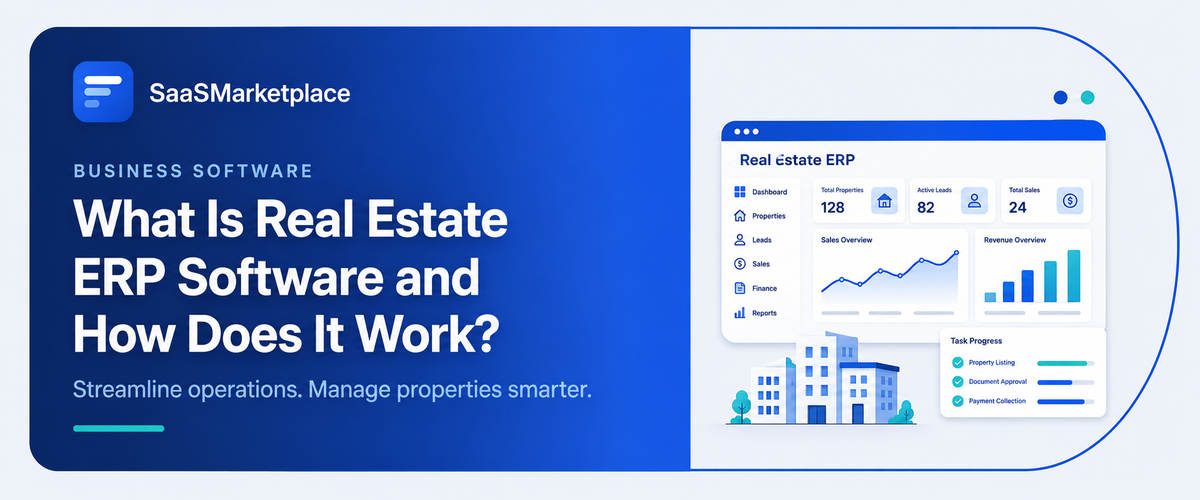
What Is Real Estate ERP Software and How Does It Work?
-min.jpg)
A property management firm running its leasing data in one system, accounting in another, and maintenance requests on a shared spreadsheet isn't unusual it's closer to the norm. The problem shows up at month-end, when someone has to manually reconcile numbers across three disconnected tools just to answer a basic question about portfolio performance.
 Looking for Real Estate ERP Software? Check out SaaS Marketplace’s List of the Best Real Estate ERP Software in the USA for your business.
Real Estate ERP software exists to close that gap by bringing financials, property operations, leasing, and reporting into a single connected system, so the numbers in one module actually match the numbers in another. For a firm managing a growing portfolio of commercial or residential properties across the US, that gap between operations and accounting is often exactly what separates a decision made on solid data from one made on a guess.
Key Takeaways
- Real Estate ERP software brings accounting, property operations, leasing, and reporting together in one system, replacing the scattered point tools most firms start out with.
- It's built on standard ERP principles, with real-estate-specific pieces layered in, lease tracking and property-level accounting chief among them.
- Property management software and property accounting software often exist inside a broader ERP platform rather than as separate, disconnected tools.
- Firms managing mixed portfolios residential, commercial, or a combination benefit most from a single system that handles both operational and financial complexity.
- Poor system integration, not lack of features, is the most common reason real estate ERP rollouts underdeliver.
What Real Estate ERP Software Actually Does
At the core, real estate ERP software links the financial and operational sides of running a property portfolio two sides that, historically, sat in separate systems and rarely compared notes. Rather than pulling data out of a leasing tool and re-entering it into accounting software by hand, everything from rent rolls to maintenance costs to lease terms lives in one place.
This matters more in real estate than in most industries because operational details directly drive the financial ones. A lease renewal changes projected revenue. A maintenance request becomes an expense tied to a specific property and unit. A vacancy affects cash flow forecasts immediately, not after someone updates three different spreadsheets. General ERP software handles this kind of cross-functional connection in any industry, but real estate ERP platforms are built specifically around how property businesses operate with property-level accounting, lease management, and portfolio reporting baked into the core system.
It's worth distinguishing this from a standalone property management tool. A basic system might handle tenant communication and maintenance tickets fine, but it usually lacks the financial depth a CFO needs for portfolio-wide reporting. ERP platforms serve both audiences from the same data, which is exactly what eliminates the reconciliation work that eats up so much time at smaller and mid-sized firms.
Why Real Estate Firms Are Moving Toward ERP Platforms
Most real estate companies started out with a patchwork setup one tool for accounting, another for leasing, maybe a spreadsheet somewhere for maintenance tracking. At a small enough scale, that's fine. A handful of people can keep everything lined up by hand without much trouble. Growth is what breaks it.
Teams usually discover this the hard way, often around month-end close. Finance pulls numbers from the accounting system, operations pulls numbers from the property management tool, and the two sets don't quite match. Someone spends days tracking down the discrepancy, which is usually a timing issue rather than an actual financial problem but by the time it's resolved, leadership is already asking questions based on numbers nobody fully trusts yet.
Portfolio diversification adds another layer of pressure. Firms that started purely residential often expand into commercial or mixed-use properties, each with different accounting requirements and lease structures. Managing that complexity across systems built for a single property type becomes increasingly unworkable, which is a big part of why mid-sized firms start evaluating ERP platforms once their portfolio crosses a certain size threshold.
The Compliance and Investor Reporting Angle
Real estate firms with outside investors face reporting demands that go beyond basic bookkeeping. Investors expect timely, accurate portfolio data, and lenders often require specific financial reporting as part of loan covenants. Many businesses assume their existing accounting software can handle this, but generating investor-ready reports from a system that wasn't built with property-level detail in mind takes far more manual work than it should.
How It Fits Into the Broader Real Estate Software Stack
Real estate ERP rarely operates as an isolated purchase it tends to consolidate several functions that companies previously handled through separate, disconnected tools.
ERP Software
At its foundation, real estate ERP software applies the same core principles as general ERP software used across other industries: a unified database, shared financial reporting, and cross-departmental visibility. What sets the real estate variant apart is the industry-specific functionality layered on top, built around how property businesses generate and track revenue.
Real Estate Software
Real estate software is a wide category, spanning everything from listing platforms to transaction management tools. ERP sits closer to the operational and financial end of that range less about marketing a property, more about running the business once it's been acquired or leased.
Property Management Software
Property management software typically covers the day-to-day operational side: tenant communication, maintenance requests, lease administration. In a real estate ERP platform, this functionality is built in rather than bolted on, which is part of what eliminates the reconciliation gap between operations and finance.
Real Estate Management Software
Closely related to property management, real estate management software extends further into portfolio-level oversight tracking performance across properties and supporting acquisition or disposition decisions. ERP platforms generally fold this reporting layer in alongside the transactional data that feeds it.
Property Accounting Software
This is where the financial precision matters most. Property management software handles property-level general ledgers, common area maintenance reconciliation, and the specific accounting treatments real estate requires that generic accounting software often doesn't handle well out of the box. Within an ERP system, this accounting layer draws directly from operational data instead of requiring a separate import process.
Real Estate CRM Software
Tracking prospective tenants, brokers, and investor relationships is the job of real estate CRM software. Some ERP platforms build this in directly; others hand it off to a dedicated CRM tool instead. Either way, connecting CRM data to the financial side gives firms a clearer view of how relationships translate into signed leases and revenue.
Construction ERP Software
For firms involved in development or major renovation, construction ERP software covers project costing, contractor management, and budget tracking specific to construction work. Firms that both develop and manage properties often need this alongside standard property ERP capabilities, since a development project has a fundamentally different financial structure than a stabilized asset.
Common Mistakes Companies Make
Real estate ERP rollouts run into trouble in fairly predictable ways, and the software itself is rarely the actual issue. Underestimating data migration. Getting years of property, lease, and financial history into a new system properly takes real planning, and it's easy to underestimate how long. Smaller companies especially tend to rush this step, and the data quality issues that creates don't usually surface until months later.
Choosing a system built for the wrong property type. Many businesses assume any real estate ERP will work for their portfolio, but in practice, systems built primarily for residential management often handle commercial lease complexity poorly, and vice versa. Matching the platform to the actual portfolio composition matters more than most buyers initially expect.
Skipping proper user training. A powerful system is only as good as the people using it understand it to be, and a team that only grasps a fraction of the capabilities gets a fraction of the value. One issue that often appears during implementation is that teams keep working around the new system using old habits, like maintaining a parallel spreadsheet, simply because they were never fully trained on the new workflow.
Ignoring integration needs upfront. Even a comprehensive ERP platform usually needs to connect with other tools a specific CRM, a tenant portal, a construction management system. Failing to plan for these integrations before implementation often means expensive rework later. Treating implementation as a one-time event. Configuration adjustments almost always turn up in the first few months, once real usage patterns start to emerge rather than test scenarios. It's worth budgeting time and resources for that post-launch stretch, not just the initial rollout.
Choosing and Implementing the Right System
There's no single right platform, since the best fit depends heavily on portfolio type, size, and how the firm operates day to day. A few considerations consistently matter across different situations. Map out the actual data and workflow needs first, before a single vendor gets evaluated. Once you understand how leases, maintenance, and accounting are currently working in your business process, it will be easy to determine if a certain system really works for you or just complicates things further.
Always choose a system that suits your particular property portfolio. A company which only handles residential portfolio is not going to require the same system as the one that manages a mixture of commercial and industrial portfolio. In addition, a system which claims to be “all inclusive” may not necessarily hold up to your accounting requirements.tact with the accounting rules a given portfolio actually runs on.
Treat data migration as its own project phase, not something squeezed into the final weeks before go-live. Getting the historical data clean and accurate is worth whatever extra time it costs.Real training, not a brief onboarding call, tends to pay off later and building in a review period after launch catches the configuration issues that only show up once the system is handling live data instead of test scenarios.
When a Full ERP Platform Isn't the Right Fit
Not every real estate business needs a full ERP system. A smaller firm managing a handful of properties may find that dedicated property management software paired with standard accounting software covers their needs well, without the cost and complexity of a full ERP implementation.
The calculation shifts as portfolio size and complexity grow. Firms managing dozens of properties across multiple asset types, with outside investors expecting detailed reporting, generally reach a point where disconnected tools cost more in manual reconciliation time than an ERP platform would cost to implement.
There's a trade-off worth being honest about: ERP systems take longer to implement and require more upfront investment than simpler point solutions. For a firm that isn't ready to commit the time and resources to a proper rollout, a partial implementation often delivers less value than sticking with well-integrated point tools until the timing is right.
Conclusion
Real estate ERP software solves a problem that grows quietly until it becomes unavoidable: disconnected systems producing numbers that don't agree with each other. The firms that get the most value from it aren't running the most feature-rich platform they're the ones who matched the system to their actual portfolio and treated implementation as an ongoing process rather than a single event.
FAQ's
General ERP software covers cross-departmental functions like finance, inventory, and operations across any industry. Real estate ERP software builds in property-specific functionality, like lease tracking and property-level accounting, that generic ERP systems typically don't handle well.
Not always. Smaller firms with a handful of properties often do fine with dedicated property management software paired with standard accounting tools. ERP platforms tend to make more sense as portfolios grow in size and complexity.
Some platforms include real estate CRM software natively, while others integrate with a separate CRM tool. It depends on the specific platform and how central relationship management is to the firm's operations.
Many platforms support mixed portfolios, but the accounting and lease structures for commercial and residential properties differ significantly, so it's worth confirming a system genuinely supports both rather than favoring one type.
Timelines vary by portfolio size and data complexity, but most implementations take several months from initial setup through data migration, training, and post-launch adjustments.