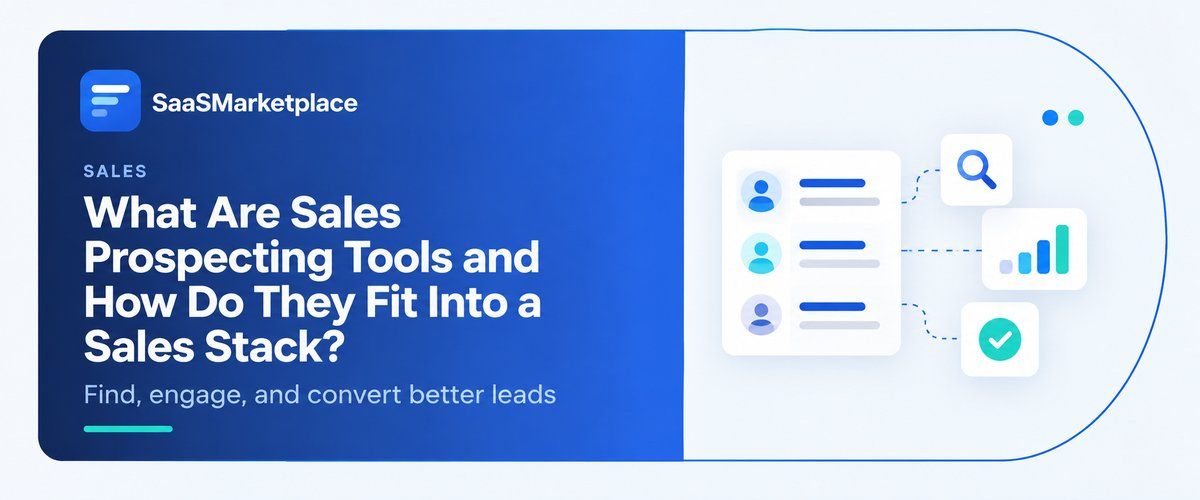
What Are Sales Prospecting Tools and How Do They Fit Into a Sales Stack?
-min.jpg)
A representative who spends the first two hours of every morning copying first names and last names from LinkedIn into a spreadsheet is not prospecting. The rep is doing expensive data entry, and sales prospecting tools are designed to take that drudgery out of the process by finding qualified contacts, verifying the information, and initiating outreach so that reps can spend their time in conversations and be much more productive. sales prospecting tools represent a broad category of sales stack software that includes a system of record, marketing infrastructure, and analytics/reporting features. This guide highlights what tools do, how they relate to and differ from CRM and marketing systems, what tools US regulations dictate, and how to structure a stack appropriate for team size, motion, and budget.
How Sales Prospecting Tools Support Lead Generation
Sales prospecting tools are defined as applications and programs that help a seller identify, research, and reach out to potential buyers before any formal opportunity has been created. In other words, that is software that answers three questions: who, how, and when to contact. Most of the products have a relational database, an email and phone verification system, and some kind of outreach automation.
This category should not be confused with lead generation and customer relationship management. Lead generation usually starts when the client fills out a form on an interested page. Prospecting starts when the seller picks a target account and goes after it, and the CRM system stores information about what happened next. Separating these terms helps recognize the gaps in one’s own sales process for better improvement.
What to Look for in Sales Prospecting Tools
Contact and Account Data
The critical factor that determines whether a prospecting tool is worth the money is data quality – more specifically, record refreshing frequency, vendor email verification capabilities, and regional coverage. Ideally, you should ask the vendor to provide a sample list of relevant companies and cross-reference it with your existing database. A tool that covers enterprise-level technology sales would have significantly smaller coverage for regional contractors or healthcare-specific organizations.
Intent Signals and Lead Scoring
Some platforms track signals like hiring changes, funding, announcements, and visits. These help their reps prioritize accounts based on signals that suggest that a prospect is more likely to buy. Signals are not always an indicator of a sale, but rather an opportunity, and a score is only as good as the rules. Teams usually find out after a quarter or two that their model needs some tweaking after seeing conversion rates.
Outreach Sequencing
Sequencing tools schedule emails, calls, and social touches across several days. Good ones stop a sequence when a prospect replies and log activity back to the system of record. Weak ones keep sending, which damages sender reputation and irritates buyers. Daily send limits and reply detection deserve as much scrutiny as the template library.
How CRM Software Supports the Sales Workflow
Sales CRM Software
Sales CRM software is focused on managing the pipeline, forecasting, quoting, and analyzing reps’ activities. Such programs are perfect for teams that want to routinize the whole sales process and control every stage. For instance, a five-person inside sales team could use a sales CRM to track the progress of leads from the moment they are imported into the program from the prospecting tool. All the replies and meetings are organized into a shared pipeline to make sure no actions are missed. The ability to set up territory rules and permissions is also important in larger organizations after the inside sales team reaches a certain size and is no longer managed by one person.
AI CRM Software
AI CRM software adds features such as automatic activity capture, deal risk flags, call summaries, and suggested next steps. The value depends on how much clean history the system has to learn from. A young company with a few hundred records may see little benefit from predictions, while a team with several years of consistent data can get more useful guidance. Treat any forecast as an input to a manager's judgment. Also ask where customer data is processed and whether it is used to train vendor models.
Online CRM Software
Online CRM software simply means a cloud-hosted system accessed through a browser or mobile app, which describes most modern products. Cloud delivery reduces setup time and makes remote access straightforward, and vendors handle updates and security patches. The trade-offs are subscription pricing that rises with seat counts and dependence on the vendor's uptime and export options. Confirm that you can export your full data set in a standard format before signing.
The Role of Marketing Systems in Sales Prospecting
Sales and marketing tools overlap more than org charts suggest. Prospects found by a rep often end up in nurture programs, and marketing leads often enter outbound sequences. Treating the two stacks as separate islands is a frequent cause of duplicate outreach and conflicting messages.
Marketing Automation Software
Marketing automation software manages lead capture, nurture tracks, scoring, and handoffs based on behavior. For prospecting, its main job is coordination. If a contact is already in an active nurture program, a rep should see that before sending a cold email. Shared rules for who owns a contact at each stage prevent the awkward situation where a buyer receives two different pitches in one week.
Email Marketing Software
Email marketing software handles newsletters, announcements, and campaign sends to opted-in audiences. It differs from sequencing tools, which support one-to-one outreach from a rep's own mailbox. Mixing the two can hurt deliverability, since bulk campaigns and personal outreach carry different reputation profiles. Many teams keep them on separate sending domains for that reason.
Marketing Analytics Software
Marketing analytics software consolidates campaign, web, and pipeline data into dashboards. It shows which channels produce engaged visitors, which content gets read, and where prospects drop out. Analytics is descriptive. It reveals patterns, and someone still has to interpret them. Sales teams benefit by learning which topics resonate before writing outreach.
Marketing Attribution Software
Marketing attribution software assigns credit to the touchpoints that preceded a deal, using models such as first touch, last touch, or multi-touch. B2B buying cycles involve many interactions, so no model is perfectly accurate. Attribution is most helpful when used to compare channels over time rather than to settle arguments about a single deal. Outbound prospecting should be tagged consistently; otherwise its contribution disappears from reports.
How Integration Improves Sales Data Flow
A stack works when data moves predictably. A simple flow looks like this: a prospecting tool finds and verifies a contact, the record syncs to the CRM, the contact is checked against marketing systems for existing activity, outreach begins, replies are logged, and reporting tools measure results. Every handoff is a place where records can duplicate or fields can map incorrectly.
|
Tool Category |
Main Job |
Typical Owner |
|
Prospecting tools |
Find and contact target buyers |
Sales development |
|
CRM |
Store records and manage pipeline |
Sales operations |
|
Marketing automation |
Nurture and route leads |
Marketing operations |
|
Email marketing |
Send opted-in campaigns |
Marketing |
|
Analytics and attribution |
Measure channels and influence |
Revenue operations |
What US Businesses Need to Know About Sales Outreach Compliance
Outbound activity in the United States is regulated. The CAN-SPAM Act regulates commercial e-mail and requires accurate identification of the sender, a clear opt-out mechanism, and honoring opt-outs promptly. The Telephone Consumer Protection Act governs telemarketing and also restricts robotic calls and texts to mobile numbers without prior permission. National Do Not Call Registry is primarily aimed at consumer phone numbers, so the use of business numbers is controlled by different regulations. In addition, the privacy laws of individual states, such as California, might entitle a person to access and delete data concerning them.
Due to the complexity of regulations, it is necessary to consult with counsel to ensure that particular practices are compliant. In addition, it is recommended to use email service providers that have suppression list management, synchronization of opt-outs, and request deletion features. This article is for informational purposes only and does not constitute legal advice.
Key Factors to Consider When Evaluating Vendors
Begin with data sourcing. Ask yourself where the company gets your contact data and if you can withdraw your consent easily. In addition, find out how often the information on your records is updated. Second, take a close look at the security aspect. Ask the provider about third-party audits such as the SOC 2 certification, single sign-on access, and data retention procedures. Third, study the pricing plan. Most companies charge every user every month, and add-ons such as extra data credits or additional mailboxes may increase the cost. Finally, find out the contract terms and conditions, cancellation policies, and hours of support. If the company offers comprehensive support before buying, there is a good chance that the same level of customer care will be provided after purchase.

Pro-tip
Before buying, export 200 contacts from your best-fit accounts and compare them against records you already know are accurate. The match rate tells you more than any vendor claim.
Sales Technology Needs Across Different Company Sizes
Small teams require fewer tools than vendors indicate. A small team of salespeople can get by with cloud-based CRM, some form of prospecting tool, and email marketing software, perhaps supplemented by marketing analytics tools. Mid-market companies are likely to invest in marketing automation when the volume of leads requires a full-time equivalent in operations. Enterprise teams, meanwhile, are more concerned with governance, permissions, and integrations into data warehouses, and may have multiple prospecting tools across different regions or segments.
The main risk at every size is buying ahead of process. Teams usually discover that sophisticated marketing attribution software adds little when campaigns are not tagged consistently, and that AI features disappoint when records are incomplete.
Avoiding Common Sales Stack Implementation Issues
Buying on a demo is the classic error. Demos use clean data and ideal scenarios. Run a pilot of two to four weeks with real prospects and measure reply rates, bounce rates, and time spent per rep.
Skipping ownership rules causes another frequent problem. Without clear definitions of who owns an account, duplicates and conflicting outreach follow. Training matters too. Reps who don't understand why fields matter tend to leave them blank, and blank fields weaken every report downstream. Many companies also overlook exit terms, such as data export and contract length, until the day they want to switch.
Do You Know?
Outbound tools and marketing campaigns often send from different systems, so a single buyer can receive messages from both in the same week without anyone noticing.
Conclusion
Sales prospecting tools are worth using if they shorten the selling chain: a live conversation with a target account, and they only do that if they are attached to a reliable record repository. Choose the CRM first, and then pick prospecting, marketing, and measurement tools that slot into it, and test them on pilot data, checking that they have the compliance features you need. And then layer in other tools only if the process proves itself. A lean stack focused on what users actually want will always beat a sprawling one full of redundant records. Do an annual audit to delete tools that serve the same function and check that data flows between the remaining ones are moving the right information in the right direction.
FAQ's
They are applications that help sellers find target buyers, verify contact details, prioritize accounts, and start outreach. Most include a contact database, email verification, and sequencing features.
In most cases, yes. Without a system of record, prospecting data ends up in spreadsheets and follow-ups get lost. A basic CRM is a sensible first purchase.
It can be, once you have consistent historical data for the system to learn from. Newer teams often get more value from clean data and clear processes than from predictive features.
Automation platforms coordinate behavior-based nurture, scoring, and lead routing across channels. Email tools focus on designing and sending campaigns to opted-in audiences. Some products combine both.
Pricing varies widely. Many vendors charge per user each month, and data credits or extra mailboxes can add cost. Request a quote based on your team size and ask what is excluded.
Both are permitted under conditions. Email must follow CAN-SPAM requirements, and calls and texts are governed by federal and state rules. Confirm your practices with an attorney.