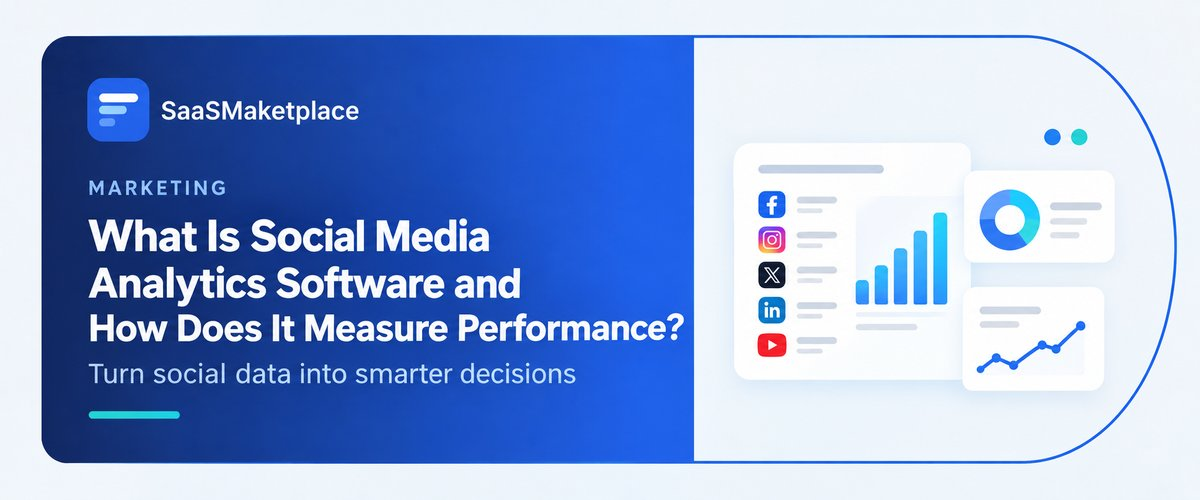
What Is Social Media Analytics Software and How Does It Measure Performance?
-min.jpg)
Followers climb month after month. Meanwhile, sales from the social channels don't move much at all. The marketing manager pulls up three different dashboards, dumps everything into a spreadsheet, and still can't tell leadership which posts actually brought in money. That's the problem this whole category was built around. Not follower counts, not likes connecting what gets posted to what the business gets out of it.
 Looking for Social Media Analytics Software? Check out SaaS Marketplace’s List of the Best Social Media Analytics Software in the USA for your business.
Platforms keep multiplying, and algorithms keep changing, so guessing what'll land isn't really a strategy anymore.Per The Business Research Company, the global market for this software sat around $17.32 billion in 2025 and is on track for $22.65 billion in 2026, growing over 30% a year as more companies drop manual reporting for automated tracking. Here's what the software actually does, how teams use it day to day, and how it compares to the neighboring tools people often confuse it with.
What it is: Social Media Analytics Software
Basically, this is software that pulls data off social platforms impressions, shares, comments, clicks, sentiment and turns it into something a team can actually use instead of a wall of raw numbers. It's built for marketing, customer service, and product teams who need to act on what's happening, not just report it upward. Social media analytics software measures and interprets what happened, why, and what's likely to happen next. Social media monitoring software listens mentions, hashtags, live conversation, usually before any real analysis kicks in. Social media management software bundles publishing and scheduling together with reporting, so analytics is just one piece of a bigger tool. Social media marketing software gets used as a stand-in for management platforms a lot of the time, though it usually cares more about campaign creation and ad targeting than measurement. Social media scheduling software is the narrowest of these publishing and queuing content, with reporting that rarely goes past basic post engagement.
Why this matters
Three things are driving the growth. First, sentiment analysis has turned into the main feature people use Fortune Business Insights says it made up over 43% of the market in 2026, since NLP can sort thousands of daily mentions by tone without anyone doing it by hand. Second, sales and marketing management has become the top use case, close to half of demand, as e-commerce brands lean on social as an actual sales channel rather than just a place to build awareness. Third, North America alone made up close to 39% of the market in 2025 this stuff has become central to how U.S. marketing teams operate.
A lot of vendors calling themselves "marketing software" have picked up the same AI features, which muddies the line between a tool built for campaign creation and one built for real measurement. Worth sorting out before signing anything. None of this means every company needs the full enterprise setup a local service business posting twice a week has nothing in common with a national retailer running paid campaigns across five platforms. But the general direction the market's heading, toward predictive analytics and tighter CRM ties, matters whether or not you're buying right now.
How the measurement actually works
- Engagement and reach:: Likes, comments, shares, saves, impressions, reach the basics. These numbers alone don't tell you much. A post can get huge reach and low engagement, which usually just means people scrolled by without stopping. Better tools weigh this against post type and timing a small team without a dedicated analyst can still notice that carousel posts on Tuesday mornings beat single images on Fridays, because the software surfaces the pattern for them.
- Sentiment and conversation analysis: The software reads through comments, replies, and mentions and sorts them by tone. It's more than a reputation thing a spike in negative sentiment right after a launch or a shipping delay can flag a problem before it ever shows up in return rates. This is also where analytics tools start overlapping with what's traditionally called monitoring software, which trips up a lot of buyers who think they're getting one thing and end up needing both.
- Audience and demographics: It's not only about what got posted; who it reached matters too. Platforms break audiences down by location, age, device, and behavior, so a team can see whether a campaign actually hit the people it was meant for, or just happened to land with someone else entirely.
- Conversion and attribution tracking: This is where things stop being basic reporting and start being strategy. By connecting to website analytics, UTM tags, and e-commerce platforms, the software can trace a sale back to the exact post or campaign that started it. It starts to look a lot like a scaled-down version of marketing automation software here, tracking a whole buyer journey instead of one post's engagement numbers.
- Competitive benchmarking: A lot of platforms let teams track competitors and stack up share-of-voice, posting frequency, and engagement side by side. Handy for quarterly planning. Not so useful when you're just deciding what to post tomorrow.
- Predictive and AI-generated insights: The newest layer, and the one behind most of the current growth, uses past performance to suggest posting times, formats, sometimes even draft captions. Still assistive rather than fully automatic it flags what worked before, but someone still has to hit publish.
Common risks in Business Analytics & Tool Adoption
- Chasing vanity metrics: A huge follower count or a viral post is worthless if it doesn't move something real sales, leads, retention, fewer support tickets. Analytics tools can show that connection, but only if the team's already agreed on what "performance" means before setup starts.
- Buying more than the team can handle: A three-person team doesn't need enterprise-grade predictive modeling if nobody has time to act on any of it. This is one of the more common reasons rollouts stall the tool works fine, there's just no process built around using it.
- Vendors selling: marketing software have leaned into the same AI capabilities, which blurs the line between campaign tools and true measurement platforms. Worth understanding that distinction before signing anything.
- Assuming one platform does it all: A lot of businesses find out the hard way that their management tool schedules fine but reports on performance in a pretty shallow way, and end up bolting on a separate analytics tool six months later. Figuring this out up front including whether the marketing software you already use gives usable performance data saves a headache mid-year.
- Skipping sentiment tracking until there's a crisis: Teams often set up engagement tracking and skip sentiment entirely, only adding it after a PR problem forces the issue. Given how big a role sentiment plays in this category now, it's one of the more avoidable gaps.
When you probably don't need dedicated software
Not every company needs a standalone platform for this. When posting sporadically, avoiding paid social ads, and focusing mainly on visibility instead of lead generation, built-in analytics within Instagram, LinkedIn, or Facebook's business tools likely sufficecombine them with a simple scheduler and consider the task finished. Specialized software becomes worthwhile once handling multiple accounts, executing paid campaigns requiring attribution, or presenting reports to stakeholders lacking direct platform access.Also, if currently funding a management utility, review its existing reporting features before purchasing another solution performing identical functions.
Questions worth asking before buying
Does the price scale with profiles, seats, or data volume, and which of those grows fastest for you? Will it plug into your CRM or ad accounts, or are you exporting data by hand forever?Does the sentiment analysis actually cover the languages and regions you work in? How much history can you pull, and is there a limit on exporting reports? Is the trial long enough to test with real campaign data instead of a canned demo?
Where this is all heading
A few things are shaping what comes next. AI content recommendations are becoming a standard feature rather than a platforms increasingly suggest what to post, not just when, based on what's worked before. CRM integration keeps getting deeper too, part of a broader move to tie social performance to actual pipeline and revenue instead of just engagement numbers. As social commerce grows, expect in-platform purchases to get treated as their own metric rather than something tracked as an outside conversion.
As sentiment and behavior reporting gets more granular at the user level, platforms will have to keep pace with regional privacy laws especially in the U.S., where the pile of state-level rules keeps growing.
Conclusion
This software has gone from a nice-to-have reporting layer to something a lot of businesses genuinely rely on to justify their social spend. Industry research the category at roughly $17 billion in 2025, headed toward $66 billion by 2030. That kind of jump says something: companies aren't satisfied anymore just knowing a post did well. They want to know why, and what to do with that next time. Whether a business needs its own platform, a feature baked into a management tool it already has, or just better habits around internal reporting comes down less to company size and more to how tightly social performance needs to connect to revenue and strategy.
FAQ's
Yes, when integrated with e-commerce platforms, CRM systems, or UTM-tagged links, it can attribute specific sales or leads back to individual posts or campaigns, moving beyond engagement-only reporting.
Not usually. Most businesses use them together management software handles publishing and scheduling, while analytics software provides the deeper performance interpretation, sentiment tracking, and reporting layer.
AI is primarily being used for sentiment classification at scale and for generating content recommendations based on historical performance, though most platforms still keep a human in the loop for final publishing decisions.
Costs vary widely by vendor and profile count, but small businesses often start with the analytics features bundled into a broader social media management software plan before investing in a standalone enterprise tool.
Weekly reviews work well for catching short-term trends and content adjustments, while monthly or quarterly reviews are better suited for strategic decisions like budget allocation or platform prioritization.