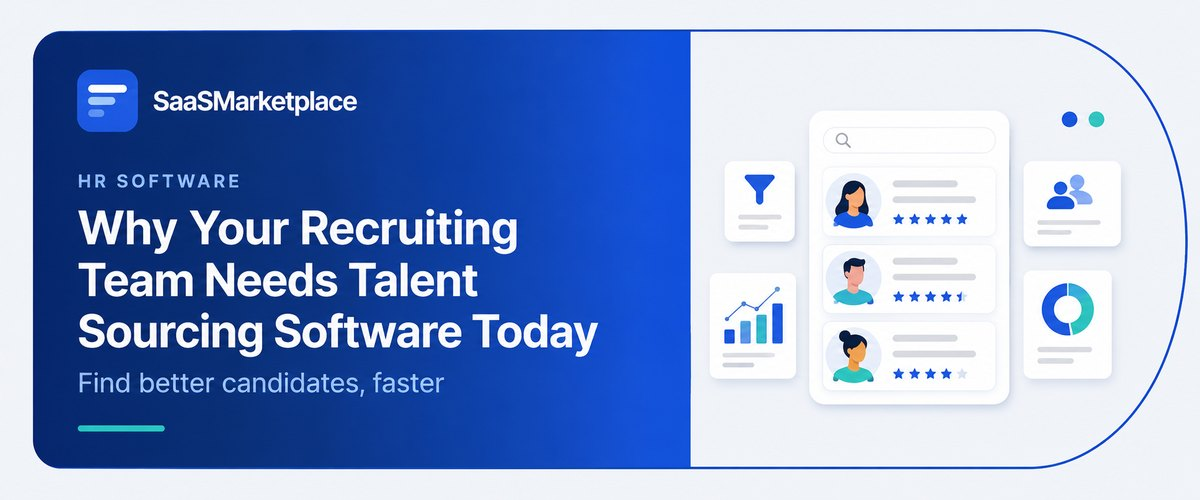
Why Your Recruiting Team Needs Talent Sourcing Software Today
-min.jpg)
In today’s hyper-competitive U.S. hiring market, just leaning on reactive job postings and the whole inbound applicant flow is kind of no longer enough to actually grab top-tier talent. Modern U.S. recruiting teams are dealing with a real structural shift, because the best candidates, especially for niche technical roles, executive positions, and other specialized tracks, tend to be passive. Like, they aren’t just scrolling job boards or jumping onto actively submitting resumes. Talent sourcing software gives talent acquisition (TA) teams proactive, data-driven instruments so they can spot, reach out, and keep building relationship pipelines with high-performing passive talent long before a requisition even shows up on the calendar. And when the sourcing tech automates those time-consuming things like candidate discovery, outreach email sequences, and market mapping, it trims time-to-fill, lowers how much you need pricey external search agencies, and gives U.S. organizations a sharper edge for winning talent in a fast-moving economy.
What is Talent Sourcing Software?
Talent sourcing software is a kind of specialized recruiting technology, built to identify, track, and then engage qualified people before they even put in an application. Different from traditional Applicant Tracking System (ATS) that kinda sit there and collect resumes from applicants already actively shopping for a role, sourcing tools instead go out and search millions of professional profiles across public platforms, niche databases, and even internal candidate archives, using automated search logic and predictive data. Basically, these sourcing platforms reassemble a candidate’s past roles, technical know-how, and career momentum, so talent acquisition teams can form focused talent pools and then send hyper-personalized automated email sequences to passive professionals.
In the U.S. hiring climate that’s shaped by a tight labor market, plus a huge wave of generic AI-generated applications, sourcing software has moved from “nice to have” into this core day-to-day operating necessity. Many U.S. employers are stuck with two problems at once: first, there’s a very high intake at the top of the funnel, but the applicants often don’t show real skill differentiation. Second, there’s a shortage of highly specialized, high-output talent in key industries. Talent sourcing software helps cut through that background noise by turning the hiring approach from broad, reactive job postings into more precise outreach that’s skills-driven. And when it automates market mapping, flags for background verification signals, and smooth candidate engagement workflows, these tools let U.S. talent teams reduce cost-per-hire, speed up time-to-fill in a major way, and consistently secure top-tier talent ahead of competitors.
Why Does Your US Recruiting Team Need Talent Sourcing Software?
The U.S. labor market is still hyper-competitive, especially for high-skilled technical and executive positions, where the best candidates seldom use job boards. With talent sourcing software, your team can shift from reactive hiring into a more proactive style, spotting and engaging that passive talent basically the 70%+ of the workforce that is willing to consider new chances but isn’t actively applying right now. Old school Applicant Tracking Systems (ATS) are mostly tuned for inbound applicants, but these days those queues are getting bloated with generic AI-generated resumes. Dedicated sourcing software basically slices through that clutter by using data enrichment plus predictive alignment, so recruiters can zero in on pre-qualified candidates through verified skills and real market intent.
By automating market mapping, profile discovery, and multi-channel email sequences, sourcing platforms really reduce that admin drag a lot. So U.S. recruitment teams can cut time to fill down fast, drive cost-per-hire lower, and stop leaning on pricey third-party agency fees, while keeping the talent pipeline more or less full. Past just speed and cost, using modern sourcing software kind of lifts your whole talent acquisition approach. These tools often include bias-reduction features, like anonymized candidate screening, plus diverse candidate discovery filters. That way, U.S. organizations can operationalize their DEI aims Diversity, Equity, and Inclusion using real measurable data, not vague intentions.
How Does Talent Sourcing Software Improve Hiring?
- Access to passive candidate pools: Helps recruiters touch that 70%+ group of professionals who aren't actively scrolling job boards by pulling together public profiles, technical repositories, and social networks into one single view, sort of unified.
- Massive drop in time-to-fill: Swaps out handmade Boolean searches with automated profile matching, so teams can assemble a shortlist of properly skilled people in hours, not weeks, and honestly it feels faster than it sounds.
- Better quality of hire: runs skill-based matching algorithms plus data enrichment to highlight candidates with the real technical qualifications, so you don't drown in generic applications.
- Automated personal outreach: Includes multi-channel email sequencing, uses personalization tokens that change on the fly, and adds automated follow-ups to push up candidate response rates.
- Meaningful cost savings: Cuts down dependence on costly third-party recurring billing agencies and those high-priced job ads by growing an internal talent database instead.
- Reactivation of existing ATS data: It automatically scans, refreshes, and brings forward the past qualified applicants that are basically hiding in your Applicant Tracking System.
- Improved diversity recruiting: Uses anonymized screening filters, hiding names, photos, and graduation dates, to reduce unconscious bias and widen the pipeline diversity, quietly but effectively.
- Useful talent analytics: Gives real-time insight into email open rates, conversion metrics, salary or market compensation benchmarks, and channel performance so recruitment strategies can be tweaked quickly.
What Features Should You Look for in Talent Sourcing Software?
- AI-powered candidate matching: It uses machine learning along with natural language processing to read job descriptions and then surface people whose skills, titles, and whole career trajectories line up with more than just a basic keyword hunt.
- Multi-channel automated engagement: Helps with automated email sequences, SMS, and InMail outreach, with those dynamic personalization tokens, drip-style campaigns, and scheduled check-ins, so the reply rates can stay higher (or at least that is the goal).
- Seamless ATS & CRM integration: Creates a two-way sync with your current Applicant Tracking System and AI CRM tools, so candidate records get updated automatically, and duplicate profiles kind of fade out.
- Contact info enrichment: It sort of automatically finds and double-checks direct work emails, personal emails, phone numbers, plus it also pulls active social profiles for passive candidates from a bunch of third-party web places.
- Diversity & blind screening filters: It has features that can mask candidate names, photos, location details, and even graduation years, so unconscious bias is reduced, and the pipeline can open up more diversely.
- Advanced analytics & pipeline reporting: It tracks outreach open rates, click-through rates, how fast responses come in, team performance metrics, and sourcing channel ROI. This way, recruiting strategy improvements happen sooner rather than later.
How Does Talent Sourcing Software Save Time for US Recruiters?
- Those manual Boolean hunts: Instead of spending like, hours building some tangled Boolean strings, you let natural language AI handle it, and you get targeted candidate shortlists in mere seconds.
- Making Candidate Outreach automatic: It runs an automated multi-touch email and LinkedIn drip, with planned follow-ups too, so you are not stuck doing 1-on-1 messages one by one, again.
- Instant contact data discovery, sort of: It pulls together and checks work emails, personal emails, and phone numbers right away, so the whole manual web searching and the guess-and-check emailing just fades out.
- One-click profile import: Browser extensions grab, parse, and upload candidate profiles right into your ATS or CRM, with basically zero manual typing or data entry.
- Rediscovering talent that is already in your ATS: It scans and refreshes those sort of dormant profiles in your existing database so you do not need to restart sourcing from scratch each time.
- Fast resume and profile summarization: Long work histories turn into quick snapshots, plus key projects plus skill sets, so your first recruiter screen goes quicker.
- Automated scheduling integration: It links up with calendar invites during the email sequence, then qualified people can self-book screening calls without the endless back-and-forth emails.
What ROI Can US Companies Expect from Talent Sourcing Software?
Investing in talent sourcing software delivers a real, measurable return on investment (ROI) across multiple core day-to-day operational areas for U.S. companies. When recruiting strategies move away from passive job listings and toward proactive candidate acquisition, organizations can recover the time they lose in productivity, reduce recruitment overhead, and land better-performing talent sooner, with less friction.
1. Drastic dip in recruitment agency fees
In the U.S., third-party staffing agencies commonly take about 15% to 25% of a new hire’s first year salary, and that can translate to roughly $20,000 to $40,000 per placement, especially for niche technology or executive roles. Talent sourcing software gives internal recruiters the detailed data enrichment, profile discovery, and contact finding abilities that external headhunters usually rely on. Bringing those capabilities in-house means cutting agency reliance by something like 30% to 50%, which leads to immediate six-figure savings each year. In practice, those gains often outrun the software’s yearly subscription cost.
2. Quantifiable boost to recruiter output
Recruiters usually spend a decent chunk of each week doing all that manual admin stuff, you know, like stitching together those awkward Boolean search strings, then going back and forth to confirm contact details, and finally entering candidate profiles into an ATS. Sourcing software handles candidate discovery, enriches profiles, and helps with more tailored email outreach, so recruiters end up saving roughly 10 to 15 hours per person every week. If you’ve got a small group of five, that’s 2,500+ hours reclaimed each year, which turns into something like $80,000+ in operational value. After that, recruiters can actually shift to relationship building, interview scheduling, and getting offers properly signed, instead of constantly hopping between little tasks.
3. Mitigation of Revenue Loss with a Faster Time-to-Fill
When a key role at a U.S. business stays vacant, day after day, it quietly drags down team output, slows project progress, or can start nudging revenue targets off course. In many cases, standard hiring timelines stretch beyond 40 days just to get the opening filled. But sourcing software can reduce time-to-fill by about 20% to 40%, because it quickly matches pre-checked passive candidates to the open requisition.
4. Reduced Turnover and Stronger Quality of Hire
The U.S. Department of Labor highlights that the total cost of a bad hire can land at 30% or more of that person’s first-year salary. Reactive job board methods also often push recruiters toward choosing whoever happens to apply, which raises the odds of mismatches, and yes, mis-hires. Talent sourcing software leans on automated skill alignment plus predictive performance signals to bring forward candidates who have proven ability and can be verified. In real terms, stronger fit among passive talent improves first-year retention.
How Does Talent Sourcing Software Compare to Traditional Recruiting?
- Sourcing Approach: Traditional recruiting mostly ends up being this passive post-and-pray type of thing, like, you just wait for active candidates to stumble onto your open listings and then apply. Meanwhile, talent sourcing software does the more proactive work, with automated data enrichment plus AI matching to find potential talent early, even before you officially post the role.
- Target Candidate Pool: Traditional recruiting kind of boxes you into active job board seekers only, so it’s about that 30% slice of the market. With sourcing software, though, you can reach the rest, 70%+ of employed professionals who may be interested in new opportunities, but they’re not really sitting around job boards all day.
- Search & Discovery Method: Traditional discovery leans on manual Boolean search strings, and then a lot of time in individual profile reviews. Sourcing software compresses this into automation, doing profile discovery, predictive skill mapping, and then ranking candidates, all in seconds, like it’s no big deal.
- Candidate Engagement: Traditional outreach often looks like manual one-off emails or phone calls, and that’s it. Sourcing tools scale outreach using automated multi-channel email drip campaigns, with dynamic personalization tokens, plus smarter follow-ups that adjust along the way.
- Data and Analytics: Traditional recruiting gives you a kinda basic applicant tracking setup inside an ATS. Then sourcing platforms sort of bring real-time market intelligence, email conversion analytics, and even some skill availability mapping.
- Time-to-Fill & Efficiency: Traditional hiring can drag on for months, mostly because you are waiting on qualified inbound flow to appear. Sourcing software trims time-to-fill by 20% to 40% using pre-built warm talent pipelines.
- Cost Structure: Traditional recruiting tends to rack up huge expenses through external search agencies ( around $20k–$40k per hire ) plus ongoing job board fees. Sourcing software lets you move executive search capability in-house, which lowers the cost-per-hire quite a bit.
Conclusion
Getting your recruiting crew set up with talent sourcing software kinda flips talent acquisition from a slow paperwork drag into a more scalable competitive engine. When it helps automate passive candidate discovery, personalize cold outreach, and then surface verified skills, these tools let U.S. organizations lower hiring expenses and lock in elite talent before other teams even get around to opening a role. If you want the right match for your recruiting stack, check out SaaSMarketplace, the main platform where talent leaders can easily discover, compare, and buy top-rated business software so they can streamline their tech surroundings and really drive modern growth.
FAQ's
An ATS manages inbound applicants who apply directly, whereas talent sourcing software proactively finds and engages passive candidates across external web databases.
It aggregates public profiles, social data, and technical repositories, using AI algorithms to match and surface qualified professionals who aren't on job boards.
Yes, modern sourcing platforms offer seamless two-way integration with major Applicant Tracking Systems and CRMs to keep candidate records synchronized.
It enables internal teams to headhunt directly, cutting reliance on third-party staffing agencies and high-cost job ad placements.
Yes, it automates manual research and messaging workflows, allowing smaller teams to match the candidate outreach capacity of large enterprise hiring departments.