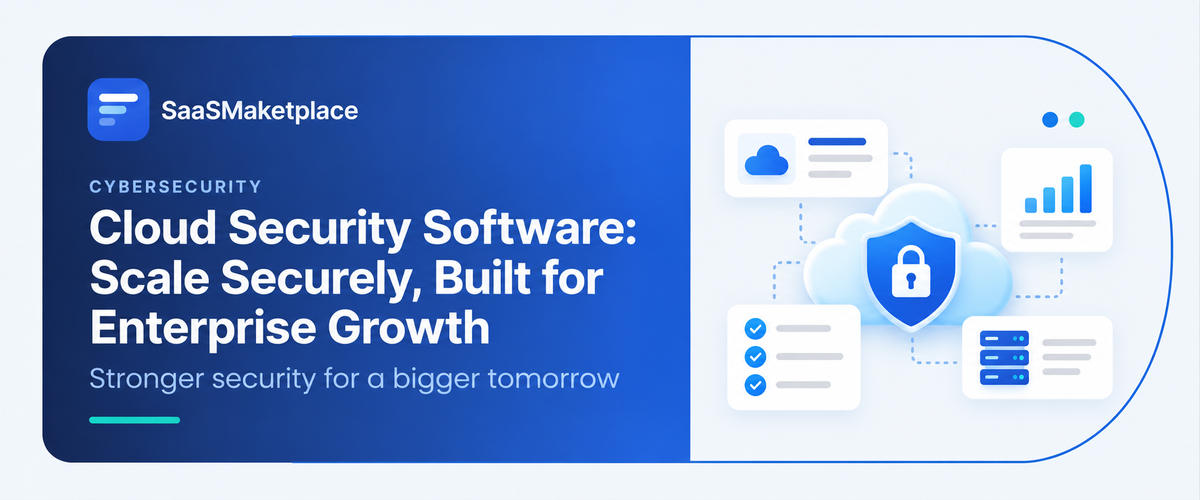
Cloud Security Software: Scale Securely, Built for Enterprise Growth
-min.jpg)
Securing digital assets amid the expansion of your IT infrastructure calls for a cloud security solution that is capable of growing alongside your company by removing the gap that arises between the fast deployment and solid compliance. Developed especially for the needs of highly growing businesses, our Cloud Security Software offers comprehensive real-time visibility, automated threat detection, and easy-to-use multi-cloud governance from within one architecture. With the help of continuous risk assessment built right into your development process and cloud environment, we enable enterprise security teams to address all potential gaps, remain in full compliance with regulations, and defeat any possible cyber attacks.
What Is Cloud Security Software?
The cloud security software can be defined as the distinct software tools and technologies that work to protect the cloud-based information, software, and virtual infrastructure. Contrary to traditional, perimeter-based systems focused on physical network infrastructure, cloud security applications are native components of distributed cloud environment. They constantly analyze data in motion, storage, and processing in order to offer an insight into system activities and actions taken by users. Through combining all basic security features including identity and access management (IAM), data encryption, vulnerability scanning, and threat detection, cloud security ensures protection of cloud assets from authorization bypassing and other cyber threats.
Modern cloud security software is based on automation for compliance governance and risk management that helps businesses expand quickly. In multi-clouds such as Amazon Web Services, Microsoft Azure, and Google Cloud, the task of managing misconfigurations, compliance, and APIs security becomes unfeasible if done manually. It is because the cloud security software makes use of automated policy management, CSPM, and machine learning-based threat intelligence that enables proactive identification of misconfigurations and neutralization of malicious activities, while ensuring least privilege access in advance.
Why Do Growing US Enterprises Need Stronger Cloud Security?
- Centralized Multi-Cloud Governance Visibility: Helps solve some serious vulnerabilities because of its centralized governance that can be achieved only due to consolidating all the governance from multiple environments (public cloud, private environment, and third-party SaaS applications) into one pane of glass.
- Misconfiguration Protection (Automated): Consistently application performance monitoring and deployment environments to detect exposed storage buckets, APIs, or other vulnerabilities that can be exploited.
- Threat Detection & Containment: Detects stolen credentials and blocks lateral propagation of threats through microservices.
- Regulatory Compliance: Helps in easy compliance with US regulations (SEC Guidelines, CCPA/CPRA, SOC 2, PCI-DSS, and HIPAA).
- Zero Trust Identity and Access Management: Eliminates the old way of having remote access networks through the use of least privilege and authentication of identity before gaining access to cloud information assets.
- Protection against Downtime: Protects from operational interruptions, extortion, and reputational damage resulting from ransomware and data breaches.
How Does Cloud Security Software Benefit Your Business?
The use of cloud security software is naturally associated with various business benefits which are more than just the provision of IT security and business growth:
- Business Growth: Enables quick implementation of cloud-based software applications, expansion into new markets, and business model innovation without any added risks.
- Risk Reduction: Minimizes the risks involved in expensive data breaches, penalties, and other corrective measures.
- Compliance: Ensures compliance through automated and audit-ready reports.
- Operational Efficiency: Resolves the issue of a bottleneck in the form of enforcement and skill assessment of security policies with automation.
- Data Protection and Image Building: Protects important customer data and helps preserve company image.
- Unified Platform for Consistent Multi-cloud Governance: Provides a unified management platform in spite of the cloud environment complexity.
What Key Features Should Enterprise Cloud Security Include?
The full-fledged cloud security system that is supposed to be adopted by organizations will include the following features:
- Cloud Security Posture Management (CSPM): Continuous monitoring of multi-cloud environments for misconfiguration, compliance drift and cloud infrastructure threats.
- Cloud Workload Protection Platform (CWPP): Cloud workload protection offers runtime security protection against malware and zero-day attacks for server and functions in virtual machines and containers.
- Identity and Entitlement Management (CIEM): CIEM allows the organization to have the least privileged access governance management by identifying over-privileged identities and orphaned credentials, among others.
- Data Security Posture Management (DSPM): DSPM finds out and keeps track of all sensitive data in the cloud and ensures that this data is well protected through encryption to avoid data breach.
- IaC (Infrastructure as Code) Scanning: This is part of the CI/CD process and helps to find out vulnerabilities, secrets leakage, and misconfigurations.
- Threat Detection and Response (CDR): Threat detection through behavior and containment in real-time monitoring with artificial intelligence telemetry from logs.
- Cloud Automation for Compliance and Governance: Cloud security posture management in relation to compliance frameworks (SOC 2, ISO 27001, HIPPA, PCI-DSS, GDPR).
- Application and APIs Security: Ensuring protection of APIs in the cloud environment against attacks, including data exfiltration.
How Does Cloud Security Software Scale With Enterprise Growth?
- API Driven & Agent-less Integration: Uses API based integration with multi-cloud which allows real-time visibility and security policy enforcement for several hundred new users, regions, and cloud services within minutes without having to install an agent.
- Automatic Discovery of Elastic Resources: Automatic discovery of new workloads, VMs, serverless services, databases, and microservices whenever spun up by the engineering teams.
- Security Guardrails Automation: Helps in embedding security policies in CI/CD pipeline and automated auditing of Infrastructure as Code templates to make sure that security practices scale in line with developer practices.
- Hierarchical structure & multi-tenant business units Governance: Hierarchical structure is supported whereby the central security team can create global policies for all the business units as well as specific policies for each business unit and product line.
- High Volume Log Analytics: Cloud native features are used to perform real-time processing and analysis of high volumes of security logs, network security and telemetry data, without having any performance and storage related concerns.
- Remediation Automation: It helps the security team from becoming fatigued due to the automation of the process of remedying repetitive risk items like closure of open buckets and removal of unwanted administrative permissions.
How Does Cloud Security Help With US Compliance and Risk?
-
Meeting Regulatory Requirements of the U.S. & Data Privacy Mandates
- SEC Cybersecurity Disclosure Regulations: Detects materiality of incidents, logs time lines, and provides real-time forensic analysis to facilitate public disclosure within the mandated 4 days of material events.
- State-Level Consumer Privacy Act (CCPA/CPRA, VCDPA, etc.): Monitors and categorizes personal information of consumers in the cloud computing system and ensures there is proper access control, encryption, and deletion of the data in accordance with the laws of that particular state.
- Regulatory Compliance (HIPAA, PCI-DSS 4.0, SOC 2, NIST): Monitors the system configuration in terms of regulatory compliance of electronic health information and payment card data security.
2. Minimizing Risks Using Automation
- Continuous Posture Assessment: Ensures no compliance gap through continuous assessment of cloud environments, detecting security holes including unsecured database connections or open network ports in real time.
- Audit Readiness Data and Reports: Automates evidence gathering and produces framework-specific compliance reports which greatly reduce legal and audit effort.
- Proactive Exposure Management: Detects vulnerabilities associated with infrastructure misconfiguration in IaC templates used in development pipeline and prevents any non-compliant infrastructure to be deployed to production.
3. Identity & Access Governance
- Zero Trust Policy Enforcement: Mitigates the risk of insider threats and credential theft by performing identity authentication and validation of device posture and contextual verification of user’s intent prior to giving access to cloud resources.
- Least-Privilege Role Management: Provides continuous analysis of identity roles in order to identify too-permissive accounts, unused access keys and privilege abuse.
What Should You Look for When Buying Cloud Security Software?
1. Full Multi-cloud & Hybrid-cloud Protection
- Full Protection of Everything: Make sure that the chosen solution offers full protection for all critical cloud services, private clouds, and SaaS applications.
- Unified Platform for Risk Management: The best solution is the one where everything can be done from a single platform.
2. Contextual Data & Attack Path Analysis
- Risk Scoring: Avoid using solutions that produce tens of thousands of alerts. Your platform should analyze misconfiguration, identities, vulnerability, and exposure to identify risks.
- Attack Path Graphs: You may want to consider if your solution can visualize the path that an attacker might follow after breaking into a system (for instance, through exposed API or identity).
3. Identity & Entitlement Governance (CIEM)
- Non-Human Identity Management: The proposed solution should tackle non-human identities as well, along with human identities.
- Enforcement of Least Privilege: Auditing the capability of identity management systems to detect too permissive access, outdated credentials, and privilege poisoning
4. Code to Cloud and Developer Tooling
- CI/CD Security Scanning: It is recommended to go for solutions which are easily integrated in the developer toolchain and perform security analysis on IaC templates, containers, and components prior to deployment.
Conclusion
With the rise in digital activities, there is an increasing need for securing multi-cloud environments to ensure continuity, privacy of customers’ data, and compliance. Deploying enterprise cloud security software provides organizations with immediate threat detection capabilities, configuration enforcement, and access management all without compromising on efficiency or risk of data breaches. To find some of the best cloud security software options to suit your technical, financial, and compliance needs, browse through SaaSMarketplace, which is the one-stop place for finding and purchasing any software.
FAQ's
Enterprise cloud security software provides unified controls, threat detection, and compliance management to protect cloud environments, data, and workloads at scale.
It automates security policies, ensures continuous compliance, and secures multi-cloud infrastructure, allowing organizations to expand without exposing assets to risk.
Essential capabilities include real-time threat monitoring, data encryption, Identity and Access Management (IAM), Cloud Security Posture Management (CSPM), and automated compliance reporting.
Yes, enterprise solutions integrate across public, private, hybrid, and multi-cloud platforms like AWS, Azure, and Google Cloud under a centralized security dashboard.
It continuously monitors cloud configurations against industry standards—such as SOC 2, HIPAA, ISO 27001, and GDPR—and generates automated audit-ready reports.