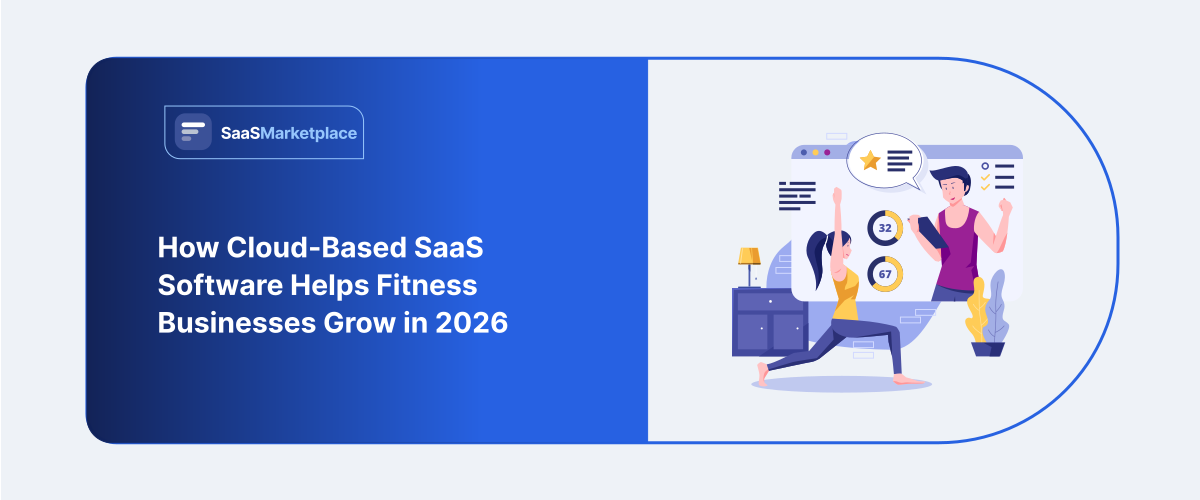
How Cloud-Based SaaS Software Helps Fitness Businesses Grow in 2026
-min.jpg)
Members kept getting double-charged for the same month. Front desk staff couldn't reliably tell who was actually enrolled in which class. Cancellation requests sat in a paper binder nobody checked on any regular schedule. Coaching wasn't the issue, and neither was training quality. It was the back office, quietly pushing people out the door faster than new sign-ups could replace them.
Versions of that story keep showing up in this industry. Fitness businesses run on a strange mix of high member turnover, thin margins, and operational complexity that looks simple from outside and rarely is once you're actually running one. A single studio might juggle class scheduling, recurring billing, trainer payroll software, retail inventory, and member communication all at once, often with a small staff covering five roles a piece. Cloud-based SaaS platforms have become standard here. Not because gym owners got excited about technology for its own sake, but because the businesses that got their operations under control started pulling ahead of the ones still running on spreadsheets and sticky notes.
Why Fitness Businesses Were Slow to Modernize Their Back Office
There are legitimate reasons the fitness industry lagged behind other small business sectors on this front. Owners are often former trainers or coaches first, business operators second, and the skills that make someone great at correcting a client's squat form don't naturally carry over into evaluating payment processing fees or comparing scheduling platforms. Margins run thin enough that a monthly software subscription can feel like a real expense to justify even when the alternative, manual errors and missed renewals, ends up costing more down the line.
There's a fragmentation problem specific to fitness, too. A single business might need scheduling, payment processing, member communication, and retail point-of-sale to all work together, and for years those lived in separate systems that never talked to each other well. A studio running one app for bookings and a different one entirely for payments ends up with staff manually reconciling two systems every week, exactly the kind of task that quietly eats hours without anyone tracking how much time it actually costs.
Smaller studios especially underestimate how much this compounds as membership grows. A single-location studio with fifty members can manage scheduling conflicts and billing questions informally, no real system needed. Push that same studio past a few hundred active members, or add a second location, and the informal approach starts breaking in ways that hit revenue directly.
What's Actually Driving the Shift to SaaS in 2026
-
Membership and Billing Automation
Recurring revenue is the backbone of most fitness businesses, and it's also where a lot of quiet revenue leakage happens. A failed payment that never gets retried. A membership that should've been paused but wasn't. Promotional pricing that never rolled back to full price on schedule. Small things individually. Add them up over a year, and it's real money, most of it slipping by unnoticed until a financial review finally catches it.
Modern billing platforms retry failed payments automatically, flag members whose cards are about to expire before a charge fails, and apply pricing rules consistently without a staff member needing to remember every exception by heart. This matters more than it sounds like it should. A studio processing hundreds of recurring charges a month can lose a real chunk of revenue to failed payments nobody retried properly, and automated dunning management alone tends to recover a meaningful share of that.
-
Class Scheduling and Capacity Management
Overbooking and underbooking are two sides of the same coin, and both cost money in their own way. A class that fills without a waitlist loses out on revenue from members who'd have shown up if given the chance. A class running at half capacity, because scheduling never accounted for actual demand, wastes an instructor's time and the studio's floor space simultaneously.
Scheduling systems that track historical attendance patterns take a lot of the guesswork out of setting class sizes and time slots; owners work off real demand data instead of a hunch. Letting members book through a mobile app instead of calling the front desk also clears a bottleneck during busy hours. Staff answering the phone genuinely can't check in the person standing right there at the counter at the same moment.
-
Member Retention Through Data, Not Guesswork
Churn in fitness businesses tends to show warning signs weeks before someone actually cancels: declining visit frequency, missed classes they usually never skip, a membership sitting untouched for three weeks straight. It's tempting to assume retention is mostly about the in-studio experience. That matters enormously, sure, but in practice a lot of preventable churn happens quietly in the background, long before anyone at the studio notices a member has drifted away.
Platforms surfacing this kind of usage data give staff a shot at reaching out before a cancellation instead of after one. A quick check-in text to someone who hasn't shown up in two weeks costs almost nothing. Every so often it saves a membership that would've otherwise quietly lapsed at the end of the billing cycle.
Common Mistakes Fitness Businesses Make When Adopting Software
A handful of patterns keep showing up across studios and gyms of very different sizes.
Choosing a platform based on price alone tends to backfire down the road. The cheapest scheduling and billing software skimps somewhere, usually payment processing reliability or customer support responsiveness, and both matter enormously the moment something breaks during a busy Monday morning rush.
Migrating member data without cleaning it up first causes trouble too. Old, duplicate, or inaccurate records tend to carry straight over into the new system, exactly as messy as before. A migration is usually the best shot a business gets at clearing out years of accumulated data debt, and skipping that step just relocates the same mess.
Underestimating staff training time creates its own headaches. A front desk team used to a simple, familiar system can genuinely struggle with a more capable platform if training gets rushed. Staff quietly falling back on old workarounds, because they never fully learned the new system, undercuts most of the reason for switching in the first place.
Ignoring the mobile member experience is a mistake owners make constantly. They focus heavily on the admin side of a platform while barely testing what members actually see on their own phones. If booking a class or updating a payment method feels clunky from a member's seat, that friction shows up eventually as lower app engagement, and later, as churn.
Assuming automation replaces the personal relationship rounds this out. Automated check-in texts and retention alerts are genuinely useful. They're not a substitute for an actual conversation, though. Studios leaning entirely on automated messaging, with no real human follow-up behind it, tend to watch members disengage from what's always been, at its core, a relationship-driven business.
One more worth naming: rolling out every feature at once instead of prioritizing the biggest pain point first. Scheduling, billing, marketing automation, retail management, staff payroll a platform might bundle all of it together, and launching the whole thing at once is tempting. Staff and members alike tend to adjust better when a business rolls out billing automation first, lets it settle for a few weeks, then layers in scheduling changes or a new booking app later. Changing everything a member touches in the same month rarely goes smoothly.
Where SaaS Fits Alongside Wearables and Fitness Apps
Studio management software and consumer fitness apps do genuinely different jobs, even though people sometimes lump them together. A member's Apple Watch, or a consumer app like Strava, tracks personal workout data. The studio's SaaS platform runs the business side of things: scheduling, billing, staffing, retention. Some platforms now integrate with wearables to pull attendance or performance data straight into the member profile, which can deepen the relationship in real ways. That integration sits on top of the core business functions, though. It doesn't stand in for them.
Businesses getting the most from their technology treat this as a deliberate stack, not a pile of disconnected apps thrown together. An employee scheduling system that can't sync with the payment processor, or a member app needing a separate login from the booking system, just recreates the exact friction cloud software was supposed to eliminate.
Measuring Whether the Software Is Actually Paying Off
Adoption numbers alone don't tell the full story. A studio can have every staff member logging into the platform daily and still be losing revenue to failed payments nobody's actually tracking closely. Specific outcomes make a better measure: failed-payment revenue actually recovered, how class fill rates shifted after moving to demand-based scheduling, whether churn dropped once retention alerts started catching at-risk members earlier.
A few months into a rollout, talking directly with front desk staff usually turns up more than any dashboard on its own. If a staff member mentions they still keep a side notebook for member requests because the platform doesn't handle something well, that's a real gap surfacing, not a personal quirk. Fixing it directly tends to cost less than letting staff quietly build workarounds around it for months.
When a Simpler System Still Makes Sense
SaaS isn't automatically the right answer for every fitness business . A very small studio with under a hundred members, run by an owner who genuinely prefers a hands-on, low-tech approach, may be better off with a simpler booking tool than a full platform loaded with features that mostly sit unused. A business mid-transition, whether that's merging with another studio or going through a full rebrand, might do better stabilizing what already works before layering a platform migration on top of an already complicated shift.
Conclusion
The shift toward cloud-based SaaS in fitness was never really about chasing new technology for its own sake. It's a response to costs that have always existed in this business: missed payments, scheduling inefficiency, preventable churn becoming easier to catch and fix now that the tools have matured enough to actually hold up for a business this operationally complex. The businesses getting real value from this treat software as infrastructure supporting the member relationship, not a replacement for it, going in with realistic expectations about staff training time and the ongoing work retention genuinely takes. Anyone still weighing their options is better off asking not whether to adopt SaaS software, but which specific operational gap is costing the most members right now.
FAQ's
Often, yes, particularly around billing automation. Even a small studio processing a few hundred recurring charges a month can lose meaningful revenue to failed payments that never get retried, and that alone frequently covers the cost of the subscription.
Mostly indirectly, through better data. Attendance tracking gives staff a heads-up on a disengaging member weeks before they cancel, which is a real chance to step in rather than finding out after the fact.
Migrating messy member data without cleaning it up first, or rushing staff training. Both tend to undercut a new platform's value regardless of how capable the software actually is underneath.
Not necessarily, though it can add real value. Studio management software exists to run the business, not track workouts, so wearable integration stays a nice-to-have rather than a core requirement for most studios.
Mainly for very small, low-volume studios where an owner handles most operations personally, or for a business mid-transition where stability matters more than adding new capability right now.