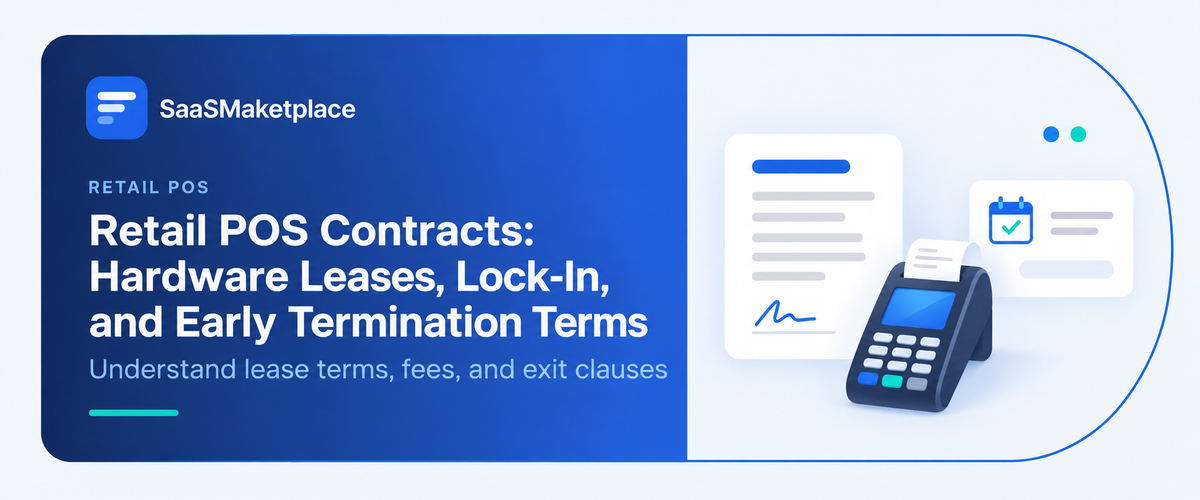
Retail POS Contracts: Hardware Leases, Lock-In, and Early Termination Terms
-min.jpg)
Merchants are often tied to POS contracts in the US retail sector due to the existence of an interrelated network involving hardware leasing, software agreements, and payment processing contracts. Equipment leases are typically for 36 to 48 months and are non-cancellable commercial finance contracts and not merely service rentals. This means that if the business goes bankrupt or is sold, the business still has an obligation to pay the entire amount due under the contract.
Moreover, vendors continue to lock customers into this ecosystem by linking proprietary hardware to proprietary payment gateways. In addition, attempts to get out of the contract before the term ends incur massive early termination fees (ETFs) or expensive liquidated damages. Furthermore, various strict contract provisions extending terms through renewal clauses give the right to punish those customers who have broken their contract.
What is a Retail POS Contract?
An agreement governing the different technological elements for transactions, including the hardware and the software utilized during each transaction, the retail point-of-sale (POS) contract is deemed a legal contract between a merchant and a POS provider. The contract further defines important aspects of POS operation, including system maintenance, transaction return rates, software level of authorization, etc. Modern POS agreements merge the different components of inventory, customer tracking, and real-time sales reporting.
In reality, POS suppliers created these contracts in such a way as to make multi-year contracts (for the period between 12 and 48 months) appear as a bundle, including equipment leasing, access governance software, and unique payment processing systems. The contracts favor the supplier heavily within oppressive terms, such as huge early termination fees (ETFs), restrictive automatic renewal periods, as well as eviction terms for hardware financing. As a consequence, switching to the competing software or getting cheaper payment terms wouldn’t be easy during the effective period of the contract.
Do You Know?
Retail Point-of-Sale (POS) contracts represent a multi-year commitment between a business and a supplier, determining all hardware-related processes, software used for transactions, and credit card transaction processes. A retail POS contract typically lasts between 2 and 4 years and guarantees payment rates and software charges for the whole term. However, the contract may contain a strict automatic renewal requirement and a hefty termination penalty associated with changing the supplier or payment processor.
Why are Retail POS Contracts so Hard to Get Out Of?
- Non-Cancellable Equipment Rental Agreements: POS equipment is often rented through non-cancellable Equipment Rental Agreements for 3 to 4 years offered by third-party leasing companies. Importantly, POS rental agreements are separate from the quality of the POS system; thus, even if the business closes, transitions to another POS solution, or faces dysfunctionality of the POS software, the business is liable to pay full lease payments, requiring personal guarantees from the business owner.
- Inaccessible Systems and Processing Gateways Lock-In: POS suppliers often combine their software with devices that are locked and proprietary, and coupled with their payment processing systems. The equipment is designed in a way that allows the software to be compatible with the hardware only, and with their merchant account. It has an influence on retailers who might get tempted by the idea of switching to the cheapest available card processor while using the existing equipment. Thus, changing the situation involves disposing of expensive card readers, terminal devices, and inventory technology in its entirety, which makes the process of switching overwhelming from the point of view of efficiency and costs.
- Liquidated Damages and Automatic Renewals: Terminating the POS contract prematurely leads to severe penalties like Early Termination Fees (ETFs) or clauses that call for the payment of all estimated fees left in the contract. Moreover, the contracts include unjust automatic renewal provisions where the merchant must inform their POS provider less than 90 days before the expiry of the contract term in writing, or else the contract will automatically renew.
Why does Leasing POS Hardware usually cost more than Buying it?
- High Rates of Interest Rates and Finance Margins Built In: With leasing companies, implicit interest rates are high, sometimes exceeding 15-30% (and even more than that), and there are also benefits administration finance costs included in monthly payments. Thus, the hardware package costing $1200 for purchase becomes $3000-4000 due to leasing that takes 36-48 months.
- Long-term Lease Rate Programs that Surpass Tech Value: Typically, hardware depreciates and loses its practical value way before 3-4 years pass. Regardless of this, they keep paying for their lease rates that were very high for the outdated terminals or card readers already worth a few hundred when new.
- Absence of Equity: When purchasing hardware, your expenses lead to the acquisition of the ownership and equity that you may get back when reselling the hardware afterward. On the contrary, under almost every lease, you pay more than market prices yet have no ownership and have to either return the hardware or pay for the expensive buyout.
- Middleman Leasing Firms: Another problem is that a number of POS sellers are not leasing the devices by themselves but are instead selling these leasing agreements to other leasing companies.
What Lock-in clauses should you watch for in a POS Contract?
- Long-term commitments: A contract that has a provision of 36 to 48 months for the period of the agreement whereby you cannot leave if the services, processing fees, or quality do not meet your requirements.
- Automatically renewing agreements (Evergreen agreements): Clauses providing that the contract will continue into another term (1 to 3 additional years) unless the party desiring cancellation has given due notice of cancellation within an extremely short time frame.
- Liquidated damages and early termination fees (ETF): A specific requirement that you pay a huge penalty for cancelling the contract early. It often implies paying the whole remaining balance of all monthly fees for the whole term of the contract instead of a reasonable amount needed for early termination of a contract.
- Non-cancelable leasing agreements: Leasing equipment agreements with third parties. You are legally obliged to pay your dues even if your business is shut down or you terminate your POS.
- The payment processing system of the vendor: A condition forcing you to use their internal payment processing system and prohibiting you from using third-party merchant processors.
- Hardware lock-in: A condition that restricts the hardware from being able to work with other POS systems; thus, all hardware will become useless if you change your service provider.
- Increasing fees: A clause providing the possibility for the POS vendor to increase any fees or commissions at any point in time without an option for the customer to terminate the contract.
- A personal guarantee you sign: This clause obliges you personally (rather than your business LLC or corporation) to meet all terms and conditions of this agreement.
How much does it cost to end a POS Contract Early?
1. Flat Early Termination Fee (ETF)
- Typical Cost: $295 to $800
- Operational model this is a stated amount that is predetermined and clearly stated in the software contract or agreement for acceptance of payments. Some providers tend to lower this amount by $100 for every year spent under the contract.
2. Damages or Other Compensation
- Cost ould be around $2,000 to $50,000+
- Operational Model Instead of a stated flat fee, this clause would essentially require you to pay out for the remainder of multi-term contracts. Your vendor calculates their average monthly processing fee (or the minimum for that month) multiplied by the number of months left in the terms of the contract.
- If your average monthly processing fees are $1,000 and you want to terminate the agreement before the end of the term with 18 months left to go, your damages would effectively be $9,000.
3. Non-Cancellable Hardware Leases (Third-Party Financing)
- Typical Cost: $2,000 to $5,000 for each terminal
- Operational Model: If you were to lease your terminal hardware through a third-party financing company, that agreement would be totally separate from your POS software agreement.
- Leases are virtually impossible to break; they have to be paid off completely including any end-of-life buy-outs or fees
What Red Flags should you catch before signing a POS Agreement?
- Long-term hardware Lease Agreements: Independent contracts for a duration of 36-48 months granted by third-party financing institutions that demand full payment even in case of your company shutting down or not using the hardware anymore.
- Liquidated damages Conditions: Sanction fulfillment requiring the commitment of 100% of all monthly subscription and processing charges if the contract is terminated early instead of paying a reasonable fixed amount.
- Short auto-Renewal Intervals: Evergreen provisions providing for a contract extension for 1-3 years unless cancellation notice is received within the defined time-frame (e.g. 30-60 days before contract expiration).
- Exclusive Locked Payment Processing: Clauses forcing you to employ only expensive offerings of the provider so that you cannot detect cheaper third-party processing services.
- One-way change of Rates Rules: Rules allowing the vendor/provider of payment services to change charging rates, monthly software fees, or PCI compliance fees anytime without the right of penalty-free termination.
- Personal Guarantees: terms indicating that you are personally generate preorders instead of just your business entity for all future lease payments, attorneys’ fees, and contractual damages.
- Proprietary hardware Dependency: Devices including terminals, registers, or card readers that are locked by software and cannot be reused, even if you decide to switch POS providers in the future.
- Ambiguous wording regarding free equipment or other promotions: promotions that provide free equipment or waive installation fees, which actually conceal long-term price increases or penalties, which require you to pay for the equipment in full if you terminate your agreement before the end of the term.

Pro-tip
Before you sign any contract, insist on a month-to-month or 12-month agreement instead of a long-term one. Specifically request to have any clauses relating to personal guarantees and liquidated damages removed. Always request that you be given the choice to buy the equipment instead of signing the lease agreement; this way, you will get the right equipment that is not locked by software and that will work with any payment processing software. Always set alerts for 120 days before your renewal date to make sure that you do not miss the auto-renewal period and get all promises—such as rate caps or free trial period terms written directly into an addendum rather than relying on verbal assurances from sales reps.
Conclusion
It is very important to know correctly how to deal with contracts connected to retail POS systems while being aware of specific lease agreements related to hardware, auto-renewal implications, and significant penalties for terminating contracts early. Agreeing for several years without mentioning matters of processing lock-ins or non-cancellable lease contracts may harm the profitability of the enterprise and limit operational ability. Retailers have to make a proper audit of the limitations associated with data processing, insist on mandatory exit clauses, and take into consideration costs associated with ownership. Using SaaSMarketplace with its platform solutions enables retailers to find and compare business applications effectively and get them easily without the necessity to enter into obligations of problematic lease contracts.
FAQ's
It is a binding agreement between a merchant and a provider that governs point-of-sale software, hardware usage, and payment processing terms.
They are structured as separate, non-cancellable commercial financing contracts that legally obligate you to pay the full remaining balance.
They are billed either as a flat cancellation fee or as liquidated damages requiring full payout of all remaining monthly minimums.
It is a provision that automatically extends your contract for another multi-year term unless written cancellation is submitted within a strict window.
Most proprietary POS hardware is locked to the vendor's in-house payment gateway, preventing you from integrating alternative card processors.