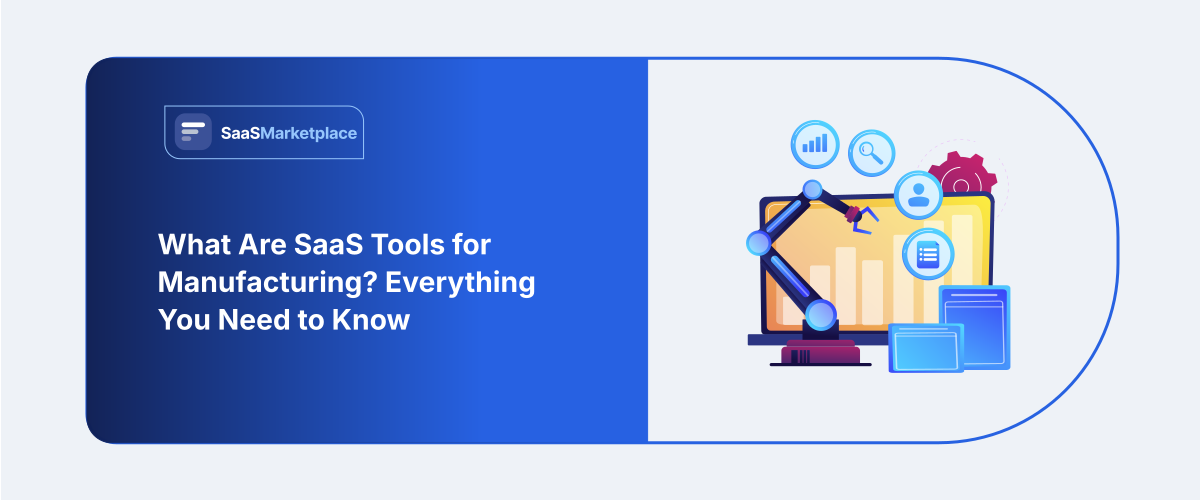
What Are SaaS Tools for Manufacturing? Everything You Need to Know
-min.jpg)
Walk into the middle of a mid-size manufacturer in the Midwest, and there is a good chance you are going to see a whiteboard with production schedules on it next to a computer running software that cost six figures. Strange mismatch. Also a common one. Manufacturing execution has always modernized its back-office and planning tools more slowly than industries like retail or finance, and part of that is simply that getting it wrong on a physical production line costs a lot more than a bug in a shopping cart ever does.
That's starting to shift, and SaaS is a big part of why. Software hosted by a vendor, paid for on a subscription, nothing installed on local servers. For manufacturers, this isn't really about swapping one type of software for another it changes how a plant sees what's happening on its own floor, how fast a problem gets caught, what it costs to keep the whole operation running day to day.
What "SaaS for Manufacturing" Actually Means
SaaS means a vendor hosts the software and you access it through a browser or app. They handle maintenance, updates, and infrastructure on their end. You pay monthly instead of buying a license and running it on your own servers.
Applied to manufacturing, that covers a wide range of tools: production scheduling, quality management, maintenance tracking, inventory and materials management, supplier coordination, shop floor data collection, and more. What ties them together isn't the function. It's the delivery model. ERP software and MES systems ran on-premise, needed dedicated IT staff just to stay alive, and came with steep licensing costs before anyone even touched a feature.
SaaS changed that math. A plant manager signs up for a quality management platform, gets access within days, pays monthly based on usage, and no six-figure implementation before seeing a shred of value. That lower barrier explains a lot of the adoption curve, especially among mid-size manufacturers who could never justify enterprise pricing before this existed.
The Main Categories Worth Knowing
Manufacturing Execution Systems, or MES, sit between planning software and the machines themselves. They track work orders in real time, monitor production progress, log machine performance and downtime. Before cloud-based MES, this kind of tracking happened manually, or through disconnected local systems that never talked to each other. A cloud MES gives plant managers a live view across one facility or several a line falls behind, and the system flags it right away instead of someone catching it hours later at shift change. Plenty of people assume MES is only for large operations. Smaller manufacturers increasingly run scaled-down versions and get the same visibility without the enterprise price tag attached.
Quality management systems (QMS ): track inspections, nonconformances, corrective actions, compliance paperwork. Matters most in regulated industries: aerospace, medical devices, food and beverage, where an audit trail isn't optional. Cloud-based QMS makes it easier to standardize quality processes across multiple plants and pull compliance reports fast when an auditor shows up asking. The biggest benefit usually isn't catching more defects. It's how much less time gets burned digging through paperwork when a customer or regulator wants documentation on the spot.
Now, as for the software itself, CMMS (computerized maintenance management system) is designed to schedule and store information about preventive maintenance, equipment history, and spare parts. After all, unscheduled downtime is costly, and maintenance is often delayed due to poor scheduling. A CMMS solution hosted as a cloud service will remind you when maintenance is due based on hours worked or dates passed, keep track of each machine’s history, and store appropriate spares based on statistics rather than guesses. Less mature companies in terms of their IT development will often ignore this category of software and attempt to maintain their equipment only reactively, which is usually too late and results in expensive downtime.
Meanwhile, supply chain and inventory management solutions are designed to track the flow of materials, work in progress, and finished products. These will sometimes integrate directly with suppliers to automate ordering, which is critical for just-in-time manufacturing to avoid shutdowns due to a local shortage.
Why This Is Happening Now
The move toward SaaS didn't happen because the technology suddenly appeared out of nowhere. Most of it has existed for years. What changed is the cost structure, and the pressure manufacturers are under just to stay competitive.
Labor shortages at the workforce level compelled producers to rely on software to replicate the decision-making capabilities previously performed by seasoned personnel. The challenges in supply chains that have characterized the industry in recent years determined the need to have real-time information on inventories and suppliers. Finally, subscription models enabled a broader pool of manufacturers to gain access to sophisticated software previously only available to major players with extensive financial resources.
A few months into running a cloud-based system, plants often notice a shift in how problems surface. Less depending on someone happening to notice. More the system catching it on its own. Doesn't mean every issue gets solved faster it means fewer of them sit unnoticed for as long as they used to.
Where the Value Actually Shows Up
Downtime reduction tends to be the clearest payoff here. Move maintenance scheduling and equipment monitoring from manual tracking to something automated, and unplanned downtime typically drops, because problems get flagged before they turn into failures rather than after the fact.
Data consistency is the other big one, especially for manufacturers running more than one facility. Get every plant onto the same cloud system, and comparing performance across locations actually becomes possible. That's usually not the case when every site runs its own spreadsheet, or a local database with formatting nobody bothered to standardize.
Faster onboarding matters more than it gets credit for, too. New floor employees pick up a cloud interface faster than legacy systems built decades ago for a completely different kind of user clunky, unintuitive, held together with workarounds nobody remembers the reason for anymore.
Where It Falls Short
None of this is free, and it helps to go in aware of the trade-offs. Connectivity is the first real constraint. SaaS depends on internet access, and manufacturing facilities, older buildings especially, or ones out in rural areas, don't always have reliable coverage across the whole floor. A platform that drops connection mid-shift leaves operators without the data they need at exactly the wrong moment. Some vendors now offer hybrid setups with local caching for critical functions. Helps, but it's not universal yet.
Legacy equipment integration is another common snag. A lot of machinery still running today is decades old, never built to talk to modern software in the first place. Retrofitting sensors or middleware to close that gap adds cost and complexity that never shows up anywhere in the subscription price.
Data security gets less attention in manufacturing SaaS conversations than it probably should. Production data can include proprietary process information, and manufacturers tied into defense or aerospace supply chains often face specific requirements CMMC in the U.S., for one that not every vendor is actually equipped to meet. Worth checking carefully during vendor selection. Not something to assume.
Subscription costs, while lower upfront than traditional licensing, creep up over time particularly once a manufacturer is running several SaaS tools that don't integrate cleanly with each other. Some plants end up paying for overlapping functionality across multiple platforms without even realizing it until a budget review forces the comparison into the open.
Not every operation gets equal value here, either. A small job shop running a handful of machines with a stable, experienced crew might not see enough return to justify a full MES rollout. In a case like that, something narrower just a CMMS, or just quality tracking usually makes more sense than a broad platform built for bigger, messier operations.
How to Actually Evaluate These Tools
Start with the specific problem, not the software category. A plant fighting downtime should look hardest at CMMS and MES. One struggling with audit readiness should prioritize QMS. Try to fix everything at once with a single platform, and you usually end up with a tool that does a lot of things okay instead of one or two things well.
Integration capability deserves real scrutiny before signing anything. Ask vendors directly how their platform connects to existing equipment, ERP systems, whatever else is already running. Vague answers here have a way of turning into expensive problems after the ink dries never before.
Worth talking to other manufacturers already using the platform, too, ideally in a similar industry, similar facility size, and asking pointed questions about connectivity issues, integration headaches, and how responsive support actually is once something breaks. None of that shows up in a vendor's sales deck. For obvious reasons.
Conclusion
SaaS has changed what's realistic for manufacturers who couldn't previously afford enterprise-grade systems. The shift toward cloud-based platforms across MES, QMS, CMMS, and supply chain tools reflects a genuine change in how plants operate, not just a new way of selling the same old software under a different pricing model. Fit still depends heavily on the specific operation. Connectivity, legacy equipment, security requirements all of it deserves an honest look before committing to anything. The manufacturers who get the most out of this tend to start with a clear problem, pick tools that address it directly, and stay realistic about what software can and can't fix on its own.
FAQ's
It depends on the vendor and the compliance requirements involved. Manufacturers in defense, aerospace, or other regulated supply chains should confirm a vendor meets specific standards like CMMC before signing, rather than assuming general SaaS security is sufficient.
Often, yes, but it usually requires additional sensors or middleware to bridge the gap. This adds cost beyond the subscription price and should be factored into the evaluation before assuming a platform will work out of the box.
No. Subscription pricing has made these tools more accessible to smaller and mid-size manufacturers, though smaller operations should be selective about which categories actually justify the investment rather than adopting a broad platform built for larger, more complex facilities.
This is a real limitation of SaaS tools. Some vendors offer hybrid setups with local caching for critical functions, but manufacturers in areas with unreliable connectivity should ask about this directly before choosing a platform.
It varies by category and facility complexity. Simpler tools like CMMS can often be running within weeks, while broader MES implementations involving equipment integration typically take several months.