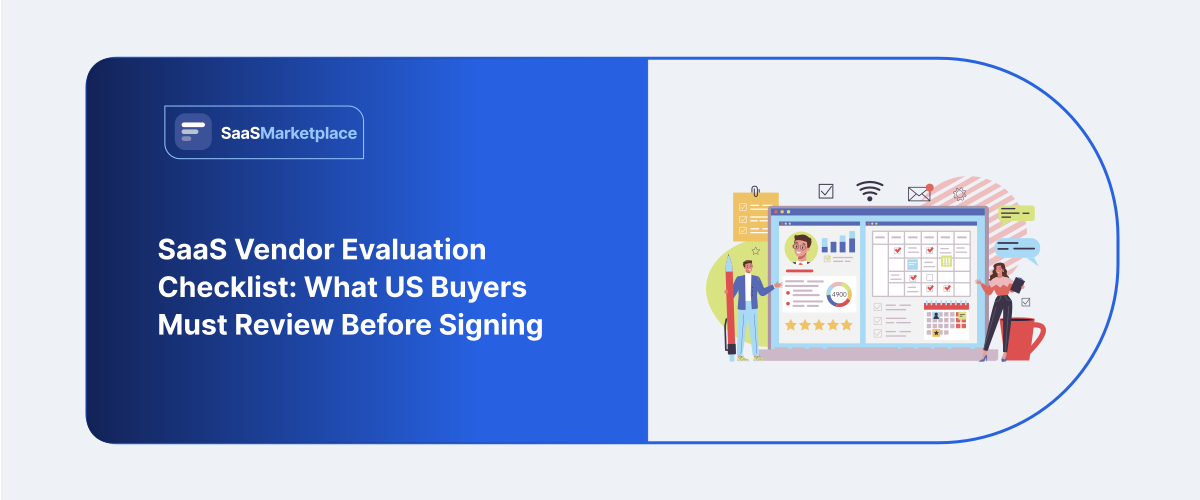
SaaS Vendor Evaluation Checklist: What US Buyers Must Review Before Signing
-min.jpg)
A mid-size logistics company in Ohio signed a three-year contract with a routing software vendor after a genuinely impressive demo. Eighteen months later, the vendor got acquired. The roadmap stalled quietly, support went from hours to weeks, and the company wanted out. Buried in section fourteen was an auto-renewal clause with a ninety-day cancellation window nobody on the buying team had caught. They ended up paying for another full year of a product they'd already stopped trusting.
Versions of that story repeat constantly, across companies of every size. Most SaaS evaluations focus almost entirely on features, pricing, and a slick sales demo, and by the time anyone actually sits down and reads the contract closely, the decision's effectively already made. A real vendor evaluation looks past the product itself into the terms, the security posture, and what happens if the relationship goes wrong. None of that shows up in a demo. All of it matters more than the feature list once the contract's signed.
Why a Feature Comparison Isn't a Real Evaluation
Comparing feature checklists across two or three vendors feels thorough. It isn't, not on its own. Most competing SaaS products in a given category end up covering roughly the same functional ground within a year or two of each other regardless. The real differences show up elsewhere entirely: how a vendor handles a security incident, what happens to a company's data if the contract ends, how fast support actually responds when something breaks during a busy stretch.
Buying teams that jump straight to a feature comparison often land on a decision that looks rigorous and isn't. A spreadsheet full of checkmarks next to expenses report software and "API access" says nothing about whether the vendor stays financially stable in three years, or whether the contract locks a company into pricing that scales badly as usage climbs. Treat the purchase like a long-term relationship with real switching costs attached. Not a one-time transaction.
What to Review Before Signing
Contract Terms That Actually Matter
Auto-renewal clauses come first. Plenty of SaaS contracts renew automatically unless a company cancels inside a narrow window, sometimes sixty or ninety days before the renewal date, and missing that window locks a company in for another full term regardless of satisfaction. Read the renewal terms carefully. Set a calendar reminder well ahead of the deadline. Small step, big payoff: it heads off one of the most common, most avoidable mistakes buyers make.
Price escalation clauses matter just as much. A contract might quote an attractive first-year price while quietly leaving room for the vendor to raise rates by an unspecified, or loosely capped, percentage at renewal. Ask what a typical renewal increase actually looks like. Push for a specific cap in writing rather than a verbal promise from whoever's running the sales call; it protects against a much larger bill somewhere down the line.
Termination rights need the same scrutiny. What happens if the vendor repeatedly misses a service level agreement? Can the company exit early if the product materially changes, or the vendor gets acquired and the roadmap shifts under them without warning? A contract letting the vendor terminate for convenience while locking the customer in regardless tilts things in a direction that rarely favors the buyer.
Security and Data Practices
A vendor's security posture needs to be verifiable, not just claimed on a slide somewhere. SOC 2 Type II reports. Third-party penetration testing summaries. Documented management of how data gets encrypted at rest and in transit. These are reasonable things to ask for before signing, not after a breach forces the question. A vendor unwilling to share this kind of documentation, or one offering only vague reassurance, is telling you something worth taking seriously.
Data residency and access controls carry extra weight for companies in regulated industries specifically, but they're worth confirming regardless of sector. Where does the data physically sit, and does that location create compliance headaches for the buyer's own regulatory obligations? Who at the vendor can touch customer data, under what circumstances, and is that access logged anywhere auditable? None of this comes up on its own during a sales pitch. That's precisely why it needs asking directly.
Integration and Data Portability
A platform connecting cleanly to a company's existing tools through documented APIs saves months of custom development down the line. Ask which systems the vendor actually has live, production integrations with, not partnerships listed in marketing copy, and ask how stable those integrations have held up over time in practice.
Data portability is the piece buyers underestimate most, by a wide margin. What happens to a company's data once the contract ends? Some vendors make export genuinely painless, handing over data in standard, usable formats within a reasonable window. Others drag it out, charge for it, or bury it in enough technical friction to function as a soft lock-in, even with no explicit clause saying so anywhere. Get the export process spelled out in writing. Test it during a trial period if the option exists at all.
Common Mistakes Buyers Make During Vendor Evaluation
A handful of patterns keep showing up across companies evaluating SaaS vendors, no matter the industry or size.
A single department driving the entire decision causes real trouble down the line. Marketing evaluating a new platform tends to focus entirely on features relevant to its own workflow automation, missing security or compliance requirements that matter enormously to IT or legal. Bringing the right stakeholders in early, even briefly it catches issues a single department would never think to look for. Skipping reference calls with existing customers is another shortcut companies take. A vendor's sales team hands over references who had a great experience every time. Ask specific, pointed questions instead, particularly around support responsiveness and what actually happens during a renewal negotiation. That surfaces a lot more than a generic reference call ever does.
Underestimating implementation and migration costs trips up plenty of otherwise careful buyers. Subscription price is only ever one slice of the total cost. Data migration, staff training, the temporary productivity dip during transition all of it adds real cost that rarely shows up on a vendor's pricing page. Signing before a real trial with actual company data is easy to fall into and expensive to live with. Demo environments stocked with sample data rarely reveal how a platform handles a company's actual workflow quirks. A short pilot with real data surfaces problems no canned demo ever will.
Treating the contract as boilerplate rounds this list out. Standard-looking terms sometimes hide clauses that matter enormously, and assuming a contract is "the same as everyone else's" without reading it closely is exactly how companies end up locked into terms they never meant to accept. There's one more, and it catches even experienced buyers off guard: negotiating everything except price. Teams spend weeks chasing a discount while waving through standard liability caps, data ownership language, and service level commitments without a second thought. Those non-price terms often matter more over the life of a contract than the discount ever will, and vendors generally expect pushback on them too, even without offering to negotiate first.
Where Procurement and IT Often Disagree
Procurement leans toward price, contract terms, vendor stability. IT leans toward security, integration complexity, and technical support quality. Both angles matter, and they pull in different directions mid-evaluation more often than people expect, particularly when a cheaper vendor has a weaker security posture, or a pricier one offers better support meaningfully.
Companies that navigate this well bring both groups in from the start, rather than letting procurement lock in a deal and hand it off to IT for sign-off once the real decisions have already been made. A vendor that looks like the best deal on price alone sometimes turns out to be the priciest option once integration costs, security gaps, and support quality all get weighed together honestly.
Common Warning Signs to Consider
Some warning signs are serious enough to end an evaluation outright, no matter how strong the product itself looks. A vendor refusing security documentation, or one getting evasive when asked directly about a past breach, is telling a buyer something important. No cap on price increases at renewal, paired with a long lock-in period, creates real financial risk a strong product simply doesn't offset.
No clear data export process, or a vendor charging a real fee just to retrieve a company's own data at contract's end, signals something too: customer retention matters more to them than genuine satisfaction. A sales team pushing hard for a fast signature, with no room for legal review or a proper trial, is often trying to lock things in before the buyer notices something they wouldn't like.
Frequent, unexplained turnover in account ownership is worth watching for as well. A vendor cycling through accounting software every few months, with no consistent point of contact and no memory of a company's specific setup, makes ongoing support genuinely difficult regardless of how good the underlying product is. Smaller signal than a security refusal, sure, but often an early sign of deeper trouble inside the vendor's own house.
Conclusion
Evaluating a SaaS vendor properly was never really about finding the platform with the flashiest feature list. It comes down to understanding what happens after the ink dries: how the relationship holds up during a renewal negotiation, what a company's actual options are if the roadmap shifts or the security posture turns out weaker than promised, how hard leaving would genuinely be if things go sideways. Buyers who get this right treat the evaluation as a joint effort between procurement, IT, and whoever actually uses the product day to day, with a real trial and a real contract review built in instead of skipped in the rush to close. The more useful question, for companies still building out this process, usually isn't which vendor has the most features. It's what happens if this particular relationship goes wrong two years from now.
FAQ's
The renewal and termination terms, honestly. Tie a great product to a punishing auto-renewal clause or a bad termination process, and it becomes a costly headache no matter how well the software itself performs.
Matters a great deal, especially for anyone handling sensitive data. A SOC 2 Type II report means a vendor's security controls have actually been verified independently over time, not just described in marketing materials.
Yes, arguably more. Smaller companies typically have less leverage to negotiate favorable exit terms after signing, which makes checking portability upfront more important, not less.
Letting one department run the decision without bringing IT, legal, or procurement in early enough. That gap tends to surface only once the contract's already signed, right when it's most expensive to fix.
Long enough to test the platform against real company data and actual workflows, not demo scenarios. A few weeks is usually plenty to surface issues no sales demonstration would reveal on its own.