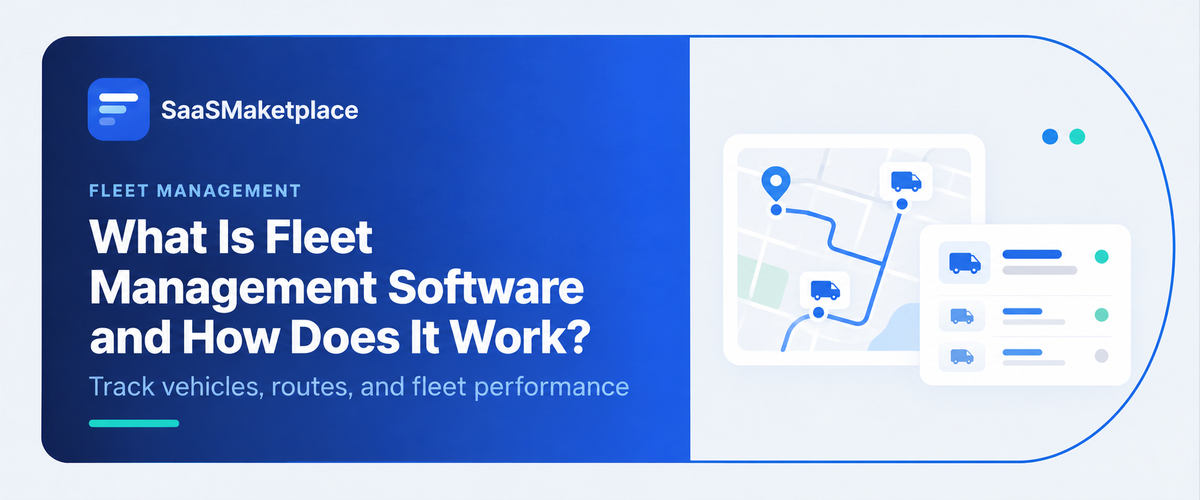
What Is Fleet Management Software and How Does It Work?
-min.jpg)
When a dispatcher receives an order of delivery via their mobile phone, they know where to send it; meanwhile, the driver says he'll be there within twenty minutes. The program gathers information on movement, such as position coordinates, velocity readings, equipment upkeep history sheets, and work hour reports, so that it can be combined easily for monitoring purposes by management personnel to take action based on it. The article explains how this product works by identifying key features, differentiating it from similar products like fleet management software and inventory control tools, while also discussing situations where an organization may not need to spend much money on them. Furthermore, this paper discusses some of the most frequent mistakes made during the contract negotiation process after signing an agreement between parties involved in a transaction.
What Fleet Management Software Does
Basicly it enables companies to manage their vehicle fleets remotely by eliminating phone calls and paperwork requirements for them. Trucks for service work, delivery vehicles, heavy duty long distance tractors and company cars are also covered by this definition. Real time information on vehicles' locations, usage statistics as well as documents about fuel use rate of an automobile repair shop are available to supervisors from this system.
Primary reasons to create this were cost and risk. Vehicles are a significant expense for transport companies because they have many small defects that build up quickly. Idle engines use up fuel. Oil service skips leads to failure. Time cap operators are at risk of violating regulations. Without any metric data these problems are not visible until they become expensive.
A lot of experts in this field call it an integration between equipment and application software for managing vehicles. An app running on an internet browser is just part of it all. There is a remainder which refers to an electronic device placed within vehicles for providing information about them.
How Fleet Management Software Works
Data Collection in the Vehicle
A telematics unit fitted inside every car collects the basic data. Many attach to the car's diagnostic socket, allowing access to details from the motor. Common metrics involve GPS position, key-on state, velocity, and error codes. Certain models incorporate accelerometers to spot severe stopping or quick changes in direction, while others link up with dashboard recorders.
Transmission and Processing
The hardware transmits information via mobile networks to the provider's remote databases, typically at intervals ranging from several seconds up to multiple minutes based on configuration. The application subsequently structures this flow into legible formats such as maps displaying active vehicle markers, records of past journeys, notifications regarding anomalous occurrences, and condensed analytical documents. Notifications represent the component responsible for altering routine operational patterns. An administrator receives signals indicating if a transport unit exits a defined zone, if motor heat levels rise sharply, or if an operator approaches a statutory speed threshold.
The Driver App and ELD Compliance
Most systems provide a driver application on mobile devices. This tool can display allocated paths, gather proof of drop-offs, and allow operators to finish car check forms using phones rather than sheets.
For trucking firms operating within the United States, the application additionally connects to electronic logging systems. An electronic logging device (ELD) captures a driver's service hours automatically, taking over from paper logbooks according to Federal Motor Carrier Safety Administration (FMCSA) regulations. Fleets subject to this requirement require hardware registered with the agency, meaning compliance verification must occur prior to purchase rather than being taken for granted.
Core Features Worth Evaluating
- Live location and routing. Dispatchers see vehicles in real time and can reassign jobs when something changes. Route planning tools suggest efficient sequences of stops, which matters most for fleets making many deliveries or service calls per day.
- Maintenance management. The software can schedule service by mileage or engine hours, track repair history, and flag diagnostic trouble codes. Preventive maintenance is typically cheaper than emergency repairs, and automated reminders reduce the chance that someone forgets.
- Fuel tracking. Reports on consumption, cost per mile, idle time, and fuel card transactions highlight waste and, occasionally, misuse.
- Driver safety. Hard braking, speeding, and harsh cornering events can feed driver scorecards. Dash cameras add video context, which helps resolve disputes and coach drivers.
- Compliance and reporting. Hours-of-service logs, inspection records, and mileage reports for tax filings sit in one place and can be pulled quickly during an audit.
Pro Tip: Before comparing vendors, list the three problems costing your fleet the most today, whether that's fuel, late deliveries, or compliance paperwork. Judge each platform on how well it addresses those, not on the length of its feature list.
How Fleet Management Differs From Related Software
Many buyers arrive at this category through a narrower search, such as tracking or logistics, and discover that vendors use overlapping labels. The table below separates the main categories.
|
Software category |
Main focus |
Relationship to fleet management software |
|
Showing where a vehicle or device is |
Provides the location layer that fleet platforms build on |
|
|
Vehicle tracking software |
Location, trip history, and basic alerts for vehicles |
Often a lighter version of fleet management without maintenance or compliance depth |
|
Transportation management software |
Planning, booking, and settling freight movements |
Manages shipments and carriers; fleet software manages the vehicles and drivers |
|
Logistics management software |
Coordinating the wider supply chain, including warehousing and orders |
Sits above fleet operations and may pull data from them |
|
Scheduling and dispatching technicians for jobs |
Pairs with fleet software when service vans need routing and tracking |
|
|
Tracking equipment, tools, and other physical assets over their lifecycle |
Overlaps when vehicles are treated as assets for depreciation and maintenance |
|
|
Counting and controlling stock levels |
Connects when goods on a truck need to be reconciled with warehouse records |
What It Costs and Where Savings Tend to Come From
Costs usually fall into four buckets: a recurring subscription per vehicle, the telematics hardware, installation labor, and the cellular data plan, which some vendors bundle and others bill separately. Training time for dispatchers and drivers is easy to forget, yet it decides whether the system gets used.
Savings, when they appear, usually come from a handful of places. Less idling cuts fuel use. Scheduled maintenance heads off some breakdowns and the towing and downtime that follow. Better routing trims miles and overtime. Some insurers also offer lower premiums for fleets with telematics and safety programs, though terms vary by carrier and aren't guaranteed.
No two fleets see the same results, and vendor claims about percentage savings deserve scrutiny. Ask for references from companies of similar size and vehicle type, and set your own baseline for fuel, maintenance, and incident costs before rollout so you can measure what changes.
Who Uses It and How
Delivery businesses use it to give customers accurate arrival times and to cut unnecessary miles. Plumbing, HVAC, and electrical contractors use it to dispatch the nearest technician to an urgent job. Construction companies track trucks and heavy equipment across several sites. Long-haul carriers rely on it for hours-of-service compliance. Municipal departments, school districts, and utilities use it to manage mixed vehicle types, often with an emphasis on maintenance and accountability.
A regional grocery distributor, for instance, might care most about delivery windows and refrigerated-trailer alerts, while a landscaping crew cares about knowing which truck is closest to the next job. Fleet size varies widely too. A company with eight vans may find a simple tracking plan enough, while a carrier with several hundred trucks needs integrations, role-based access, and detailed reporting.
Common Mistakes Teams Make
- Buying for features nobody will use. A long list of capabilities looks impressive, but dispatchers and drivers typically use a fraction of them. Adoption matters more than breadth.
- Neglecting driver buy-in. Drivers sometimes see telematics as surveillance. Teams that explain what's tracked and why, and use the data for coaching instead of punishment, usually see fewer complaints and better results.
- Ignoring data quality. Mismatched vehicle names, missing odometer readings, and unassigned drivers lead to unreliable reports. Clean records at the start save time later.
- Underestimating installation. Fitting devices across a large fleet takes planning, since vehicles must be pulled out of service for short periods.
- Not checking integrations. The platform should connect with accounting, payroll, dispatch, and maintenance systems. Without those connections, staff end up re-entering data by hand.
What to Consider Before You Buy
Compliance comes first for trucking operations. Confirm that the ELD component is registered with the FMCSA and that the vendor supports the reporting your operation needs.
Hardware matters too. Ask what devices are required, who installs them, and whether they work across the vehicle types in your fleet, including older ones. A mixed fleet of cars, vans, and heavy trucks can create gaps.
Pricing usually combines a monthly fee per vehicle with hardware costs, and contract lengths vary. Plans change often, so request current quotes directly and read the terms for early termination and data export.
Check for an open API or ready-made connections to the systems you already use. A fleet platform that can't share data becomes another silo.
Also look at driver privacy. If vehicles are used for both work and personal trips, find out whether tracking can be limited outside working hours. Policies and state laws differ, so involve legal counsel where needed.
Finally, run a trial on a small group of vehicles. Test the mobile app with actual drivers and see whether alerts are useful or merely noisy.
When Fleet Management Software May Not Be Necessary
A business with two or three vehicles, short routes, and a manager who knows where everyone is may not need a platform. A basic GPS tracker or even a shared calendar could cover the need. Companies that rarely use vehicles, or that outsource transportation entirely, would also gain little.
Likewise, if the main goal is managing freight and carriers instead of vehicles you own, transportation management software may fit better. The right test is whether vehicle costs and compliance risk are large enough to justify the subscription and the effort of rolling it out.
Conclusion
Fleet management software is worth considering when vehicles are a significant cost, when compliance carries real consequences, or when customers expect accurate arrival times. The strongest results tend to come from companies that start with a few clear problems, choose a platform their drivers will actually use, and review the data regularly.
Before signing a contract, confirm compliance requirements, check how the system connects to your other tools, and pilot it with a small group. If you only need to see where vehicles are, a simpler tracker may do the job and cost less.
FAQ's
It is a platform that collects data from vehicles and drivers, such as location, speed, fuel use, and hours of service, and presents it in a dashboard for managing costs, safety, and compliance.
A telematics device in each vehicle reads engine and GPS data and sends it over a cellular network to cloud servers. The software turns that data into maps, alerts, and reports.
No. Vehicle tracking software shows location and trip history, while fleet management adds maintenance, fuel, driver safety, and compliance features.
Usually not. Transportation management software handles freight, carriers, and shipments, while fleet management focuses on the vehicles and drivers a company operates.
Many platforms offer integrations or open APIs, which can connect vehicle data to asset records or stock levels. Confirm which connections a vendor supports before buying.
If your operation falls under FMCSA hours-of-service rules, yes. Check the agency's requirements, since exemptions exist and rules can change.