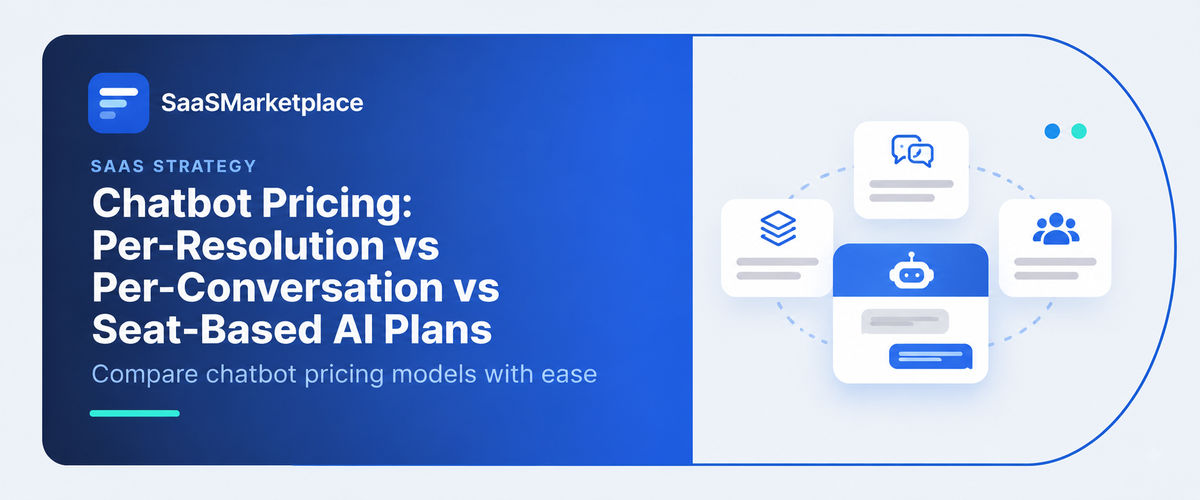
Chatbot Pricing: Per-Resolution vs Per-Conversation vs Seat-Based AI Plans
-min.jpg)
Two AI chatbot vendors can offer similar features and still produce very different monthly bills. One charges for each customer issue the AI resolves. Another charges for every conversation it handles. A third charges by the number of support agents using the platform, with AI usage billed separately.
That is where it becomes more complicated to compare the pricing of a chat bot with the subscription-based prices. It's important to know what they're counting, what happens when you use more than you're paying for and which fees are not included in that plan.
This blog breaks down three common pricing models for AI chatbots, offers tips for calculating a monthly expense, and provides insights on the things to look out for before entering a contract.

Quick answer
Per-resolution pricing charges for qualifying outcomes, per-conversation pricing charges for qualifying interactions, and seat-based pricing charges according to licensed users or agents. The model you choose depends on your support volume, team size, the automation results you are looking for and how the vendor bills.
What Are the Main AI Chatbot Pricing Models?
The three models measure different things, so their prices are not directly comparable without considering usage. When evaluating conversational AI platforms, consider how each vendor measures usage.
- Per-resolution pricing: You pay when the AI meets the vendor's definition of a resolved customer issue.
- Per-conversation pricing: You pay for each conversation that meets the vendor's billing criteria, regardless of whether it ends in a resolution.
- Seat-based AI pricing: You pay for licensed users, usually human support agents. AI automation may be included, limited, or charged separately.
Per-Resolution Pricing: Pay for Issues the AI Resolves
How per-resolution pricing works
Per-resolution pricing is a pricing structure where the vendor bills the customer for each request that they submit that fits the vendor's definition of “AI resolve.” This may be a response to a product query, resetting a password for a customer or finishing a qualifying account-related task.
But a resolution is not necessarily defined the same way by vendors. For instance, Intercom records a resolution when their AI agent offers a resolution, and the customer either agrees the solution was satisfactory or walks away without seeking further assistance.
That distinction matters. If someone no longer responds, they could have gotten the reply they were looking for or may have just dropped the thread entirely. Before assuming that each billable resolution is a completely solved issue, read through the vendor's rules for measuring.
Advantages and limitations
Per-resolution pricing ties charges to automated outcomes, making it useful for repeatable requests when you can measure genuine resolution.
The trade-off is that your bill may increase as the chatbot resolves more issues. Check how the vendor bills reopened tickets, repeat contacts, partial resolutions, and human handoffs.
Who should consider it?
This model can suit businesses that handle predictable, repeatable support requests and want to track the cost of each automated outcome.
Pro-tip
Ask vendors for sample billing records showing how they classify a successful resolution, a reopened issue, and a conversation transferred to a human agent. Test those definitions against real support cases before signing.
Per-Conversation Pricing: Pay for Customer Interactions
How per-conversation pricing works
Under per-conversation pricing, the vendor charges for each qualifying interaction handled by the chatbot. The price usually depends on the agreed rate and the number of billable conversations.
What is considered one conversation is the important question. A vendor can specify a defined session window, a customer touchpoint through a specific channel or another rules that have been documented. If several messages are sent in the same conversation, they can be included in that single conversation, and a later contact about the same problem can be a new interaction.
For instance, Salesforce offers a conversation-based Agentforce pricing model in addition to others that are consumption-based. It also has an ad-published pricing page, and it is priced at $2 per conversation, but it's important to check the product terms and current commercial terms before budgeting.
Advantages and limitations
Per-conversation pricing makes spending easier to estimate when customer interaction volume is reasonably stable. You can forecast costs using expected conversations and the contracted rate.
You may still pay for conversations that need human help, and seasonal spikes can increase costs.
Who should consider it?
This model may suit businesses with predictable traffic, clear conversation definitions, and a need to automate initial support across website chat or messaging channels.
Do You Know?
A conversation and a resolution are different measurements. One conversation can contain many messages but only one billable outcome, depending on the vendor's rules. That is why the cost per chatbot conversation should never be compared directly with the cost per AI resolution without checking what each rate includes.
Seat-Based AI Pricing: Pay for Licensed Users
How seat-based pricing works
In the case of AI pricing, it is based on seats and therefore depends on the number of licensed users or support agents. If the chatbot is responsible for most of the routine questions, a business could still pay for eight seats, even if only eight agents are licensed.
This is a typical setup in customer support systems where AI is integrated with ticket management, shared inboxes, reporting and collaboration tools. For instance, Zendesk's subscription pricing model is agent-based and includes AI agent functionality alongside rules of usage for automated resolution. The subscription and the AI billing thus must be considered together.
Advantages and limitations
The biggest advantage is predictability when your team size stays stable. Finance teams can estimate the core subscription without forecasting every customer interaction.
However, costs rise when you add agents or require higher-tier licenses. And if AI reduces the number of human-handled tickets, your seat count may not decrease. Additional AI usage charges can also apply.
Who should consider it?
Businesses that require an entire customer support system, a somewhat consistent staff, and human agents to process more complex or sensitive requests are better suited for seat-based plans.
Do not assume a seat license includes unlimited AI automation. Check the included allowance, whether AI usage is metered, and whether additional seats are required for supervisors or other users.
Per-Resolution vs Per-Conversation vs Seat-Based Pricing
The right chatbot pricing comparison starts with the unit being billed, then considers how the cost changes as your business grows.
|
Factor |
Per-Resolution |
Per-Conversation |
Seat-Based |
|
Billing unit |
Qualifying resolutions |
Billable conversations |
Licensed users |
|
Main cost driver |
Number of resolutions |
Number of conversations |
Number of seats |
|
Predictability |
Depends on resolution volume |
Depends on interaction volume |
Often better with stable headcount |
|
Main risk |
Disputed resolution definitions |
Paying for interactions needing human help |
Paying for unused seats |
|
Best fit |
Measurable automated outcomes |
Predictable interaction volume |
Human-led support teams |
How Much Does an AI Chatbot Cost? A Practical Pricing Example
When comparing the cost of an AI chatbot per month, ensure you are using a workload that is comparable between the models, as these are not necessarily the same prices from different vendors.
Let's say that a US online retailer is processing 2000 customer conversations per month. Its chatbot resolves 60% of them, with the business getting 1,200 AI resolutions and 800 conversations that are not resolved by AI.
For illustration, assume the following hypothetical rates:
|
Pricing Model |
Illustrative Rate |
Monthly Calculation |
Monthly Cost |
|
Per-resolution |
$1 per resolution |
1,200 × $1 |
$1,200 |
|
Per-conversation |
$0.50 per conversation |
2,000 × $0.50 |
$1,000 |
|
Seat-based |
$80 per seat, 5 seats |
5 × $80 |
$400 |
These figures compare billing formulas, not equivalent feature packages. A seat-based subscription may have separate AI usage charges or lack the automation included in a usage-based plan.
How to calculate AI chatbot costs
- Per-resolution: Billable resolutions × rate per resolution + other fees.
- Per-conversation: Billable conversations × rate per conversation + other fees.
- Seat-based: Licensed seats × rate per seat + AI usage and other fees.
When calculating AI chatbot cost, include any required base subscription and account for minimum commitments or overage rates.
Hidden Costs to Check Before Choosing a Chatbot Plan
- Platform fees: A base subscription may be required before you can use AI features.
- Usage allowances: Check how many conversations, resolutions, messages, or credits your plan includes.
- Overage charges: Find out what happens when usage exceeds the monthly allowance.
- Implementation and integration: Connecting the chatbot to your CRM, order system, or help desk may require extra work.
- Human-agent seats: AI automation may sit on top of a separate support subscription.
- Model and channel costs: Some plans charge separately for model usage, messaging channels, or advanced capabilities.
- Contract terms: Check annual commitments, minimum spend, and whether unused allowances expire.
Do You Know?
A platform may offer a low per-resolution price tag but charge an additional subscription fee for key functionality, such as help desk. This means that the real cost per resolution is the total possible monthly spend divided by the number of actual resolutions, not just the resolution unit rate.
How to Choose the Right Chatbot Pricing Model for Your Business
Your support operation should determine the pricing model, not the other way around.
- Choose per-resolution pricing when your AI handles repeatable requests and you can verify successful outcomes. Review how resolutions, escalations, and reopened issues are billed.
- Choose per-conversation pricing when you can forecast interaction volume and want to budget around a clearly defined unit. Pay particular attention to conversations that still require human support.
- Choose seat-based pricing when your team needs a full support platform and the number of licensed agents is relatively stable. Confirm whether AI usage is included or billed separately.
If your business needs both human support tools and automated customer service, a hybrid subscription may make sense. In that case, evaluate the base fee and AI charges together.
Before choosing among AI chatbot pricing models, calculate the expected bill using your own interaction history. If you are still evaluating vendors, compare relevant options in
Chatbot Software on SaaS Marketplace and verify each vendor's current pricing and contract terms.
Questions to Ask Before Signing an AI Chatbot Pricing Contract
Use these questions during vendor demos:
- What exactly counts as a billable resolution or conversation?
- Are repeated, reopened, failed, or escalated interactions charged?
- What happens when we exceed the included usage?
- Are human-agent seats and integrations billed separately?
- Can we export usage reports and reconcile them with our support records?
- How would the bill change if conversation volume doubled?
- Can we test the platform using real support scenarios before committing?
Pro-tip
Provide all shortlisted vendors with the same number of agents, channel requirements, volume and resolution rate each month. Request a written quote of cost of normal use and peak use. It's more useful to compare equal workloads rather than just headline prices.
Conclusion
A good chatbot pricing model will depend on your support costs driver. In addition to resolution pricing, there's per-conversation pricing and seat-based pricing, which is defined by licensed users.
Before you make a commitment, estimate your monthly bill, work out what each billable unit is and factor in subscription and integration costs you will need. What you see on the surface as cheap at low volume can become unattractive as you add more customers.
FAQ's
The monthly AI chatbot cost depends on the vendor, pricing model, usage volume, included features, and integrations. Calculate the subscription and usage fees together to estimate your actual spending.
Per-resolution pricing charges for qualifying outcomes, while per-conversation pricing charges for qualifying customer interactions. A conversation may be billable even if the AI does not resolve the issue.
Not always. Per-seat vs usage-based AI pricing depends on the number of licensed agents, conversation volume, AI usage charges, and included features. Compare total costs using the same workload.
Under some chatbot pricing plans, yes. Per-conversation models may charge for eligible interactions regardless of outcome, while per-resolution models use their own resolution criteria. Always check the billing terms.
Check the billable unit, included usage, overage rates, contract commitments, integration fees, and human-agent seat costs. Also confirm that you can track usage and verify billed resolutions or conversations.