Software RFQ: What to Include and How It Differs From an RFP
-min.jpg)
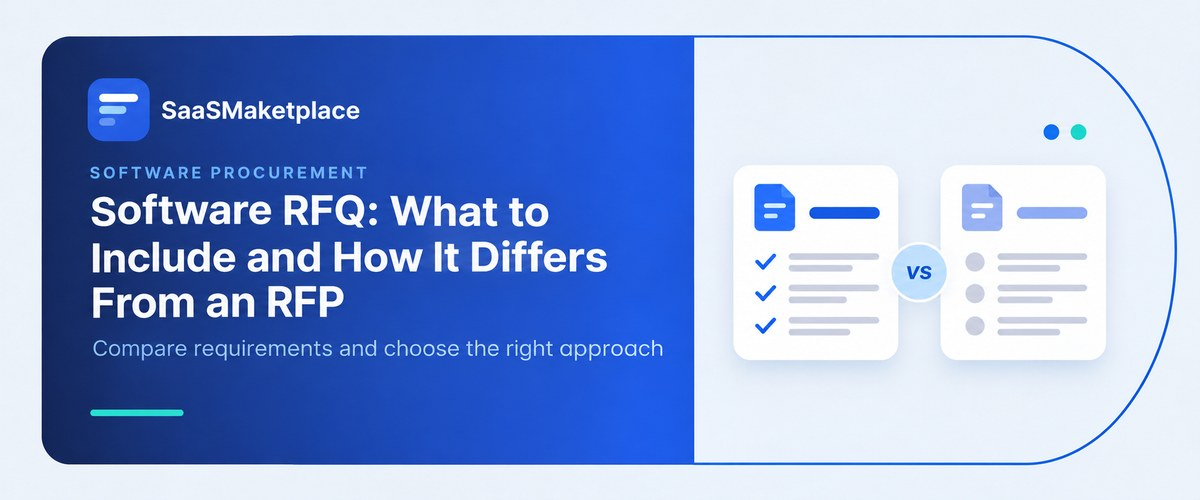
Within the American technology and business purchasing space, the Request for Quote (RFQ) and Request for Proposal (RFP) are different purchasing tools for software purchases, determined mainly by project definition and purchasing intention. A Software RFQ is issued when an organization has complete technical requirements that cannot be negotiated (buying pre-defined SaaS subscriptions, off-the-shelf software, and predefined cloud infrastructure), and what the purchaser is looking for is price and delivery schedules from various vendors. A Software RFP is issued when an organization is dealing with strategy-driven, complex, or custom software projects, where a business problem or objective is described by a purchaser, who wants to see a proposed solution architecture and methodology from the vendors.
What is a Software RFQ?
In the US technology procurement environment, an RFQ is used when there is already a specific software product that a company needs and all that is required is the price from vendors. While discovery processes are usually quite open-ended and give lots of possibilities for creative problem-solving, using an RFQ is not leaving many chances for it because, in this case, the client already knows what kind of software they are going to buy in terms of scope, functionality, licensing, or infrastructure needed.
An RFQ is one of the fastest ways for US business buyers to buy software solutions while minimizing risks and setting cost benchmarks. An RFQ removes all the fancy sales presentations from the table and leaves only real competition among vendors in terms of unit prices, implementation costs, payment conditions, and SLAs. Be it renewal of bulk SaaS licenses, purchasing shrink-wrapped software, or expansion of standard cloud hosting environments.
Why are More US Companies using RFQs to Buy Software?
- Commoditization/Standardization of SaaS Architecture: There is no question that software technology has come a long way over the past ten years. Buyers of common software types do not need vendors to bring forward any innovative architecture ideas because of how well-known specific feature sets and integration capabilities are. Thus, buyers will go directly into pricing by an RFQ.
- Extreme Reduction in Cycle Time of Procurement: Drafting, disseminating, evaluating, and negotiating an RFP typically takes anywhere from 4 weeks to 8 weeks or even more. An RFQ will force the comparison of bids side-by-side, which will only take 1-2 weeks. This will reduce the cost of internal administration greatly, as well as decrease software procurement time.
- CIO/CFO Budget Constraints/Procurement Cost Optimization: With current macroeconomic situations being tough, enterprise software spending has been put under close review by CFOs. The RFQ will remove any sales pitch and get right to the bottom line of purely financial CRM factors such as pricing per unit, bulk discounts per seat, licensing costs over multiple years, and overages.
- Implementation of Automated Procurement Platform: Modern enterprise e-procurement systems allow the IT sourcing team to issue RFQ forms automatically, obtain line-item quotations automatically, and conduct automatic bidding without having to go through hundreds of pages of proposals.
- Reduced Procurement Risks: In instances where the IT department procures licenses for already evaluated or ready-to-use software, using an RFP process will introduce unnecessary complications. The use of the RFQ guarantees that the vendors adhere strictly to the compliance and SLA criteria without compromising on the pricing.
What Should You Include in a Software RFQ?
1. Background Information & Instructions for Submitting RFP Responses
- Description: Description of the company, background information of your technology environment, and explanation of why your organization has decided to purchase. Information About Deadline Dates, Contact Person(s), and Timeframe for Decision
- Making: Clarification about deadlines for submitting responses and timeframe for making a decision, including vendor Q&A sessions.
- Evaluation Criteria: Information about what criteria will be used in the process of evaluating the responses submitted by vendors (for example, 60% total cost of ownership, 20% SLA performance, 20% compliance).
2. Exact Technical Specifications
- Number of Licenses/Users: Number of licenses/users needed exactly (for example, 500 enterprise licenses, 1,000 user accounts, API calls).
- Functional Requirements: List of functions which are not subject to discussion.
- Integration & Environment Requirements: Technical specifications of the systems into which the software should integrate.
3. Data Security, Compliance and Governance
- Security Certifications: Security certifications required by the US government that the vendor is supposed to meet (such as SOC 2 Type II certification, ISO 27001).
- Regulatory Compliance: Industry-specific regulations (such as HIPAA in the health care industry, FedRAMP in the governmental sector, PCI-DSS for payment processors).
- Data Residency and Privacy: Industry-specific regulations for where data will be stored, backup plan, compliance with state/federal data privacy regulations.
4. Mandatory Cost Breakdown Template
- Licenses/subscription cost: Tiered pricing model for per seat/per usage pricing with 1-year, 3-year, or 5-year subscription.
- Implementation and Onboarding Fees: Fixed implementation and onboarding costs.
- Support and Maintenance: Price of Tier 1/Tier 2 support and dedicated account manager/customer success program.
- Overages/Expansion Pricing: Pricing associated with adding users and overages.
5. SLAs/Operations
- Uptime Requirements: Minimum uptime required for the system (99.9% uptime, 99.99% uptime), along with a money-back guarantee if it is not met.
- Response Times: Time period allowed to fix a specific issue based on the severity of the issue (15-minute response time for critical failures).
- Maintenance Windows: Defined windows for performing system updates and patches.
How does the software RFQ process work in the US?
Step-by-Step Software RFQ Process
Internal Requirement Freeze and RFQ Creation
- IT, Security, and Procurement units establish the must-haves, capacity, integration, and compliance requirements (for example, SOC 2 Type II).
- Procurement creates the standard cost breakdown form, enabling all vendors to quote based on the identical line items.
- Vendor Short-listing and Release of RFQ
- The procurement unit selects 3 to 6 software providers or their respective resellers able to fulfill the requirement.
- The RFQ is issued through the electronic procurement portal or directly to the enterprise sales staff. There is a deadline for submitting the RFQ (typically 1 to 2 weeks).
Vendor Q&A Opportunity (Optional)
- A small period of time is allocated to the vendors for submitting their technical or commercial questions.
- The buyer shares the answers to these questions anonymously among all the selected vendors.
Proposed Bid and Proof of Compliance
- Suppliers will present their offers for price, SLA, security, and any deviations from the contract terms.
- The sourcing team conducts the first stage of validation for the mandatory criteria.
Financial Bid Comparison and Line Item Evaluation
- The procurement department conducts a comparison analysis of proposals with Total Cost of Ownership (TCO) model in mind, with different contract terms (1 year/ 3 years).
- Bid evaluators consider all hidden factors that may impact costs of the deal, like fees for implementation, caps on yearly price increase, levels of support, and overages.
Shortlisting of Suppliers and BAFO (Best and Final Offer)
- Buyer decides on the two best proposals and uses competitive quotes to negotiate one more time on prices and additional services (for example, free implementation, better support).
Award of Contract and Deal Execution
- The most suitable proposal is awarded with regard to commercial value and compliance.
- Legal conducts the signing of the Master Service Agreement (MSA), Order Form, and Statement of Work (SOW).
How is a software RFQ different from an RFP?
1. Degree of Spec Detail
- RFQ: The buyer gives a technical spec sheet in strict line-item detail. Suppliers fill in standard price sheets and check for adherence without changing the scope.
- RFP: The buyer provides a description of functional abilities requirements, current pain points, and the context. The suppliers give detailed narrative proposals that explain how their software operates, their data architecture, their plans for the project, and change management plans.
2. Dynamics of Evaluation & Selection
- RFQ: Selection is simple and objective. As all vendors are bidding on the same spec, the contract goes to the vendor with the lowest TCO, or best payment terms, or SLA’s.
- RFP: Selection is subjective and multi-faceted. Scoring matrices assess past performance of the vendor, qualifications of the team, security stance, elegance of the solution, and product roadmap of the vendor, among other things.
3. Execution Speed and Administrative Cost
- RFQ: Minimal drafting cost for the purchaser and quick turnaround time for vendors. It skips the long process of discovery calls, specialized sales demonstrations, and presentations.
- RFP: Costly process for both parties involved. Requires significant scoping internally before issuing, followed by a weeks-long process of presentations, proof of concept (POC) demonstrations, and proposal reviews.
When should you use an RFQ instead of an RFP?
1. The Software Requirements Are 100% Defined
- You are aware of the exact solution: You are renewing the licenses of existing enterprise software, increasing the number of users on an existing SaaS platform, or extending typical cloud services.
- There is no requirement for technical discovery: You do not need vendors to discuss workflow, assess your business processes, or offer different architectures of systems.
2. You Are Acquiring Commodity Software
- Standardized feature set: The product category offers standardized capabilities (for example, identity management software solutions, endpoint protection solutions).
- Vendor parity: There are multiple software vendors or Value Added Resellers (VARs) who can offer you the same functionality out-of-the-box.
3. Procurement Through Value-Added Resellers (VARs)
- Price competition between distributors: When procuring big-name OEM products (Cisco, VMware, Palo Alto Networks, etc.), you create an RFQ and send it to multiple VARs (CDW, SHI, Insight, etc.) in order to make them compete for margin reductions, rebates, and favorable commercial terms.
4. Time-Sensitive and Efficient Procurement Process Is Crucial
- Tight deadline: Rather than spending 1 to 2 months in the RFP process, you need to sign a contract in 1 to 2 weeks.
- Budget for administration activities is limited: Your sourcing team does not wish to go through vendor presentation, proposal evaluation, and POC testing stages.
5. Saving Money Is the Sole Criterion
- CFO / Budgetary constraint: Your procurement objective is purely budgetary: get volume discounts, reduced implementation cost, cap multi-year contract, etc.
What Common mistakes should you avoid in a Software RFQ?
- Vague Technical Requirements: By not specifying detailed requirements for integration, API, or the actual seat/metric requirements, the vendor quotes the baseline package, leaving you with costly changes later.
- Non-standardized Pricing Matrix: By leaving the cost sections open-ended, vendors will be allowed to submit their own custom pricing matrix and, thus, will not allow for true apples-to-apples financial comparison of costs.
- Failure to Consider All Associated Costs: Concentrating purely on licensing fees without considering implementation costs, data migration, support options, overages, and annual pricing increases results in budgeting problems.
- Over-specification of Scope (RFQ Instead of RFP): An RFQ issued for a customized software development project makes vendors compete in price alone when, in fact, your project needs more than that - it needs a consultative approach and architecture design.
- Not Mentioning Mandatory Compliance: Not taking into consideration the mandatory compliance of the data security (SOC 2 Type II, HIPAA, ISO 27001) is wrong since you have to save yourself time and not consider any proposal from a vendor that is not compliant.
- Not Setting up SLA and Downtime Penalties: It will be a mistake on your part if you do not set the uptime guarantees (at least 99.9%), as well as the support response times and downtime penalties.
- Unreasonable Deadline for Proposal Submission: The deadline of less than a week to submit proposals can only result in wrong or incomplete proposals from the vendors or lack of participation of the top vendors.
- Failure to Include Baseline MSA/Terms: Defining legal terms at a later stage after determining a vendor winner provides leverage back to the seller and can lead to negotiations on payment terms (Net 30/60) for weeks.
Conclusion
The approach to procurement of B2B software depends on the level of understanding of the project, where an RFQ would be used if specifications are set in stone and pricing is required, or an RFP would be used when vendor strategies are needed for solving a difficult situation. The modern B2B SaaS marketplace platforms speed up this evaluation cycle by ensuring that there is one platform that enables procurement teams to explore, compare, and buy business software without any hassle.
FAQ's
An RFQ focuses strictly on exact costs and pricing structures for known specifications, while an RFP asks vendors for strategic solutions, features, and project proposals.
Use an RFQ when you have clear, non-negotiable software specifications and simply need side-by-side cost comparisons from pre-vetted vendors.
A complete RFQ must include core technical requirements, license volume needs, implementation timelines, SLA expectations, and a standardized pricing breakdown table.
Yes, organizations often issue an RFP first to evaluate software vendor solutions, followed by an RFQ to negotiate precise costs with the shortlisted candidates.
Since requirements are already well-defined, vendors typically need 1 to 2 weeks to submit accurate pricing estimates and terms.