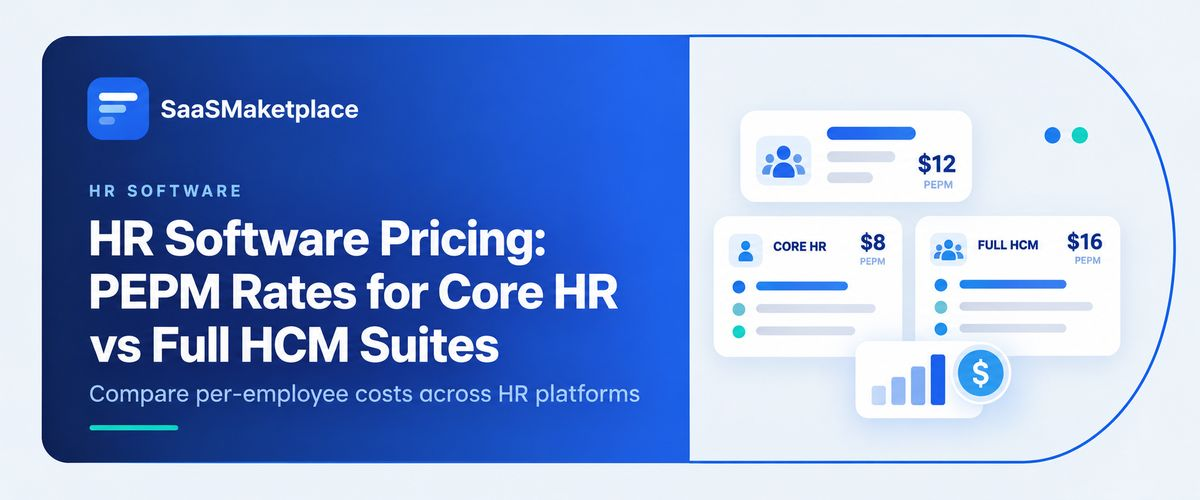
HR Software Pricing: PEPM Rates for Core HR vs Full HCM Suites
-min.jpg)
A $10 per-employee-per-month HR subscription can look affordable until you discover that payroll, benefits administration, and advanced reporting cost extra. A full human capital management (HCM) suite may have a higher starting price, but it could replace several separate tools and reduce the work involved in keeping employee data consistent.
That is why comparing HR software pricing requires more than checking the monthly rate. You need to understand what each plan includes, how the vendor calculates employee charges, and which additional services your business will need.
What is PEPM Pricing in HR Software?
PEPM means per employee per month. Under this model, your HR software subscription depends on the number of employees covered by the platform.
For example, a business with 100 employees paying $10 PEPM would have a base subscription of $1,000 per month, or $12,000 per year. That calculation excludes setup fees, paid modules, taxes, and other charges.
Monthly base cost = PEPM rate × billable employee count
The billing rules matter. A vendor might calculate fees using active employees, total headcount, or another definition stated in the contract. Some providers also set a minimum monthly charge, so a small company may pay more per employee than the advertised rate suggests.
Before comparing proposals, ask each vendor to explain its employee-count policy, minimum fees, billing frequency, and rules for adding or removing employees.
Do You Know?
A low PEPM rate does not always mean a lower total bill. Separate charges for payroll, benefits, and integrations can change the cost significantly.
How Much Does HR Software Cost Per Employee?
There is no single standard price for HR software. Costs depend on the vendor, the features included, the size of your workforce, and whether you need a basic HR information system or a broader HCM platform.
BambooHR provides a useful example of published pricing. Its public starting rates for organizations per employee are $10 for Core, $17 for Pro, and $25 for Elite. The company also states that smaller organizations receive flat monthly pricing and that volume discounts may apply. Payroll, benefits administration, and time tracking can carry separate charges.

Note: Verify the current quote with the vendor before budgeting, as published rates and plan details can change. These are examples from one vendor, not universal market averages. Other HR software providers use custom quotes or package-based pricing.
What Does a Core HR Subscription Usually Include?
A core HR plan generally handles everyday employee administration. Depending on the product, it may include:
- Employee records and a searchable directory
- Digital documents and onboarding workflows
- Time-off requests and approval processes
- Employee self-service
- Standard HR reports and dashboards
- Basic integrations with other business applications
For a small company moving away from spreadsheets, these features may cover most immediate requirements. But if your team needs payroll processing, benefits enrollment, complex performance reviews, or workforce analytics, check whether those capabilities are included or sold separately.
The distinction is important when you compare HR software. Evaluate the features attached to each plan rather than treating the entry-level price as the cost of the complete system.
What is the Difference Between HR Software And Full HCM Suites?
The difference between HR and HCM is mainly the breadth of functionality, not simply the number of features shown on a pricing page.
Core HR software focuses on employee administration. HCM software can extend that foundation to talent acquisition, employee performance management, compensation planning, workforce analytics, and other stages of the employee lifecycle. Some HCM suites also include payroll and benefits, while others price these capabilities separately.
|
Comparison factor |
Core HR software |
Full HCM suite |
|
Main purpose |
Manage employee records and routine HR tasks |
Connect HR administration with broader workforce processes |
|
Employee data |
Central records and employee profiles |
Central records with wider talent and workforce data |
|
Recruiting |
May offer basic hiring tools or a separate module |
May include applicant tracking and recruiting workflows |
|
Payroll |
Often separate or integrated through another provider |
May be included or offered as an additional module |
|
Performance management |
Basic or limited features |
Often includes reviews, goals, and talent development |
|
Reporting |
Standard HR reports |
May include advanced analytics and workforce planning |
|
Implementation |
Often simpler for straightforward needs |
May require more configuration, migration, and training |
|
Pricing approach |
Base subscription or PEPM |
Bundled, modular, or custom pricing |
Does a Full HCM Suite Always Cost More?
Not necessarily. The answer depends on the functions you need and the products you currently pay for. Consider a company using one tool for employee records, another for payroll, and a third for performance reviews. A full HCM suite may have a higher subscription price but could replace some of those separate subscriptions.
On the other hand, if the company only needs employee records and time-off approvals, buying a broad suite may add costs without delivering much practical value. Look at the complete workflow. If payroll data, employee status changes, and benefits records need to move between separate systems, account for the cost of integrations and the effort required to maintain them.
How Do Core HR And Full HCM PEPM Rates Compare?
A side-by-side cost model helps you see how quickly a small difference in PEPM pricing affects your annual budget. The following figures are illustrative, not market-wide averages or vendor quotes.
|
Example pricing model |
Core HR |
Full HCM |
|
Assumed monthly PEPM rate |
$10 |
$25 |
|
Employees |
100 |
100 |
|
Monthly base subscription |
$1,000 |
$2,500 |
|
Annual base subscription |
$12,000 |
$30,000 |
At these assumed rates, the HCM subscription costs $18,000 more per year before add-ons or implementation. That difference may be justified if the suite replaces other paid systems or supports workflows the company genuinely needs.
However, the calculation changes when additional modules enter the picture. A core HR plan that charges separately for payroll, benefits administration, and time tracking may end up closer to the HCM quote than its base rate suggests.
Use the same headcount and feature requirements when requesting vendor proposals. Otherwise, you may compare a basic subscription against a package that includes several additional services.
What Hidden Costs Should You Check Before Buying HR Software?
Subscription fees are only one part of the budget. A reliable purchasing decision accounts for the costs required to deploy, connect, and maintain the system.
1. Payroll and Benefits Administration
Payroll software may be included in some packages and priced separately in others. Confirm whether the quote covers payroll processing, tax calculations and filings, direct deposit, year-end forms, and the number of payroll runs your business needs.
Benefits administration can also carry an additional charge. Ask whether the price covers enrollment workflows, eligibility rules, carrier connections, and employee changes throughout the year.
2. Implementation and Data Migration
Moving from spreadsheets or an existing HR system takes more than importing a CSV file. Employee identifiers, job titles, reporting relationships, compensation fields, and historical records need to map correctly.
Ask whether the vendor charges for implementation, data cleanup, configuration, or administrator training. For a larger deployment, request a written scope of work that identifies responsibilities, testing steps, and the expected go-live date.
3. Integrations and API Access
Your HR platform may need to exchange data with accounting software, identity management tools, benefits providers, time clocks, and recruiting systems.
Check which integrations are included and whether API access has usage limits or additional fees. For custom integrations, ask how the platform handles authentication, field mapping, failed requests, duplicate records, and data synchronization.
A connection that sends employee updates to payroll is not enough on its own. You also need to know what happens when an employee changes departments, becomes inactive, or receives a new compensation rate.
4. Support, Training, and Contract Minimums
Some plans provide standard online support, while larger customers may need dedicated assistance or paid training. Contract minimums, annual commitments, renewal increases, and employee-count adjustments can also affect the amount you pay.
Pro-tip
Request a written cost breakdown covering subscription fees, required modules, implementation, integrations, support, and renewal terms. Use that same checklist for every vendor. This makes it easier to identify the actual cost of ownership before your business commits to a platform
How Can You Calculate the Total Cost of an HR System?
Start with the annual subscription, then add every required expense that falls outside the base plan.
Annual software cost = annual base subscription + required add-ons + implementation and service fees
For a more useful comparison, prepare a first-year budget and a recurring annual budget. Implementation and migration may be one-time expenses, while subscriptions, support plans, and paid modules usually recur.
For example, a 100-person business evaluating two vendors should record:
|
Cost item |
What to confirm |
|
Base HR subscription |
PEPM rate, minimum fee, and billing rules |
|
Payroll and benefits |
Included services and extra charges |
|
Implementation |
Setup, migration, configuration, and training |
|
Integrations |
Native connectors, API access, and custom work |
|
Support |
Included service level and premium support costs |
|
Renewal |
Contract term, price adjustments, and cancellation terms |
Do not ignore internal administration time. If a lower-priced platform requires employees to reconcile records manually across several applications, the subscription savings may come with additional operational work.
You can also estimate the cost per employee by dividing the annual total by the average number of employees covered. This gives finance and procurement teams a more realistic figure than the headline PEPM rate alone.
Which HR Software Pricing Model is Right For Your Business?
The best fit depends on the complexity of your HR processes, the systems you already use, and your plans for growth.
When Should a Small Business Choose Core HR Software?
Small business HR software is worth considering when your immediate needs are employee records, onboarding, time-off tracking, document management, and self-service.
A focused platform can keep costs easier to manage when payroll and benefits are already handled by suitable systems. Before buying, confirm that the software can support your expected headcount and provide the integrations you need.
When Should You Consider Enterprise HR Software or a Full HCM Suite?
Enterprise HR software and full HCM suites may suit organizations with multiple departments, complex approval structures, larger recruiting needs, or broader reporting requirements.
A connected system can help HR, finance, and managers work from consistent employee records. Still, confirm that the suite supports your payroll setup, permissions model, reporting requirements, and integration needs. A long feature list does not guarantee that the workflows will fit your business.
How Should You Compare HR Software Vendors?
When considering your options, evaluate payroll software if payroll plays a significant role in your decision-making process. Before choosing a vendor, ask these questions:
- What is the total price for our current headcount?
- Which features are included in the quoted plan?
- Are payroll, benefits, recruiting, and analytics separate modules?
- What setup and migration work will we need to pay for?
- Does the platform integrate with our existing applications?
- What will the contract cost at renewal?
- Can we add users or modules without changing the entire plan?
A structured comparison helps you focus on the product that meets your needs, not simply the vendor with the lowest advertised rate.
Conclusion
HR software pricing makes the most sense when you compare the system's full cost, not just its PEPM rate. Core HR may be enough for businesses that need reliable employee administration, while a full HCM suite can suit organizations that want connected payroll, talent management, and workforce reporting. Before signing a contract, check module fees, implementation costs, integration requirements, and renewal terms. A clear cost comparison will help you choose software that fits your current needs and plans.
Related Reads:
- Top Enterprise HR Software for Large Organizations in 2026
- HR Software Cost Per Employee: 2026 Pricing Guide
- Best HR Employee Mobile Apps for Modern Workplaces
- Best HRIS Software: HRIS vs HRMS Explained (2026)
- Top HR Compliance Changes Businesses Need in 2026
- Best HR Analytics Software for Smarter Workforce Decisions
FAQ's
PEPM means per employee per month, a subscription model where the monthly fee depends on the number of employees covered.
Core HR often has a lower starting price, but paid modules and integrations can reduce the difference in total cost.
Some HCM suites include payroll, while others offer it as a separate module or through an integration.
Include implementation, data migration, integrations, training, support, paid modules, and renewal terms.
Give each vendor the same headcount and feature requirements, then compare first-year and recurring costs.